Screenless Learning Doesn’t Sit Still: Why the Real Classroom Is Everywhere Except a Desk

Nobody ever learned how to handle real pressure while sitting perfectly still.
Not in a training room.
Not while clicking through slides.
Not by dutifully completing modules.
They learned it while staring at a half-finished coffee, replaying a meeting that didn’t land the way it was supposed to. They learned it while walking back to their desk, wondering how a simple conversation spiralled into tension. They learned it while repeating a sentence in their head and wishing they could take it back.
That is where learning actually happens.
Not in neat hours.
Not in tidy outlines.
But in motion — when people are thinking, doubting, rehearsing.
The problem with sitting still
Most corporate learning is still designed for ideal conditions: quiet rooms, attentive learners, uninterrupted time blocks. It assumes people will pause real work to prepare for it.
But work doesn’t arrive with warnings.
It arrives as a client who changes direction mid-call.
As a decision that can’t wait for tomorrow’s workshop.
As a conversation that doesn’t go the way the script said it would.
And yet, we keep building learning as if work politely waits.
Sit.
Focus.
Consume.
Return unchanged.
The result? Content that looks impressive, but vanishes the moment pressure shows up.
The invisible classroom
At Edufic, we think of learning as something that travels.
It follows people into the moments no calendar captures:
The commute where someone finally realises what the real problem is.
The corridor where a leader understands why their team went silent.
The coffee break where a mistake stops feeling random and starts making sense.
These moments are invisible to most learning strategies — yet they shape behaviour more than any formal session ever could.
This is the real classroom.
And it doesn’t have a desk.
What screenless learning really means
Screenless learning is not about removing technology.
It is about removing friction.
It is about designing experiences that do not demand a login, a pause, or permission. Audio-first journeys that feel like someone thinking with you. Cinematic stories that don’t explain work — they simulate it. Serious games that replace clicks with choices. AI-powered workflows that transform lived experience into guidance people can access in motion.
Not content people finish.
Judgement they carry.
Why movement changes behaviour
People do their best thinking when they are not being asked to “learn”.
They think when they are walking. Waiting. Recovering. Reflecting.
When learning meets them there, it stops feeling like training and starts feeling like instinct.
That is the difference between remembering a framework and becoming capable.
Learning that refuses to sit still
At Edufic, we design learning that refuses to stay put.
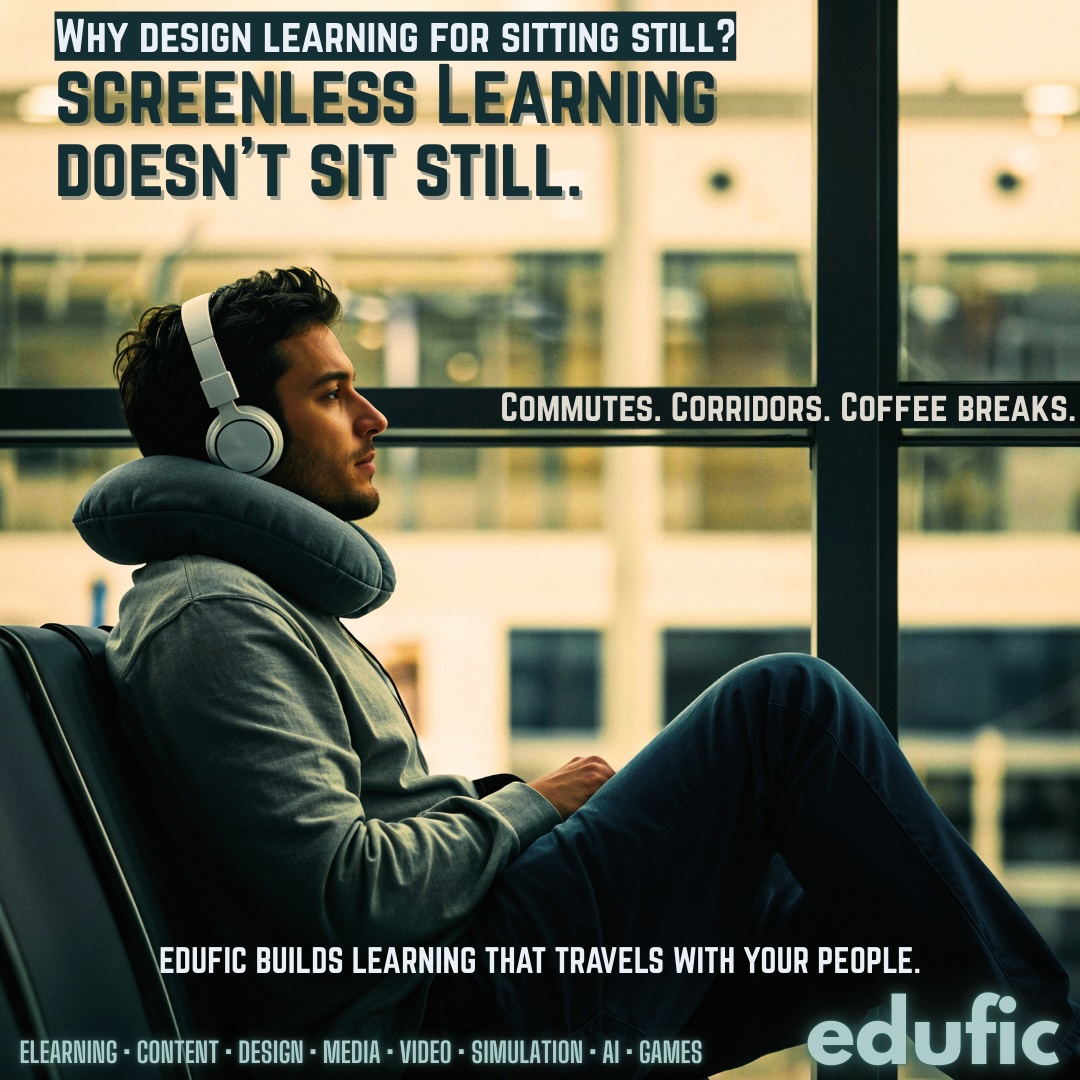
It travels with your people — into commutes, corridors, coffee breaks, and all the small spaces where real decisions are rehearsed long before they are made.
Because when learning moves with you,
work finally moves too.
And that is when behaviour actually changes.