
Orchestration Over Automation: Designing AI-First eLearning That Actually Scales

If you’re designing your AI-first learning pipeline, it’s worth pausing for a moment of honest reflection.
Because right now, most organisations are buying AI tools the way we once bought home gym equipment.
With conviction.
With enthusiasm.
And with the quiet hope that ownership alone will produce results.
It rarely does.
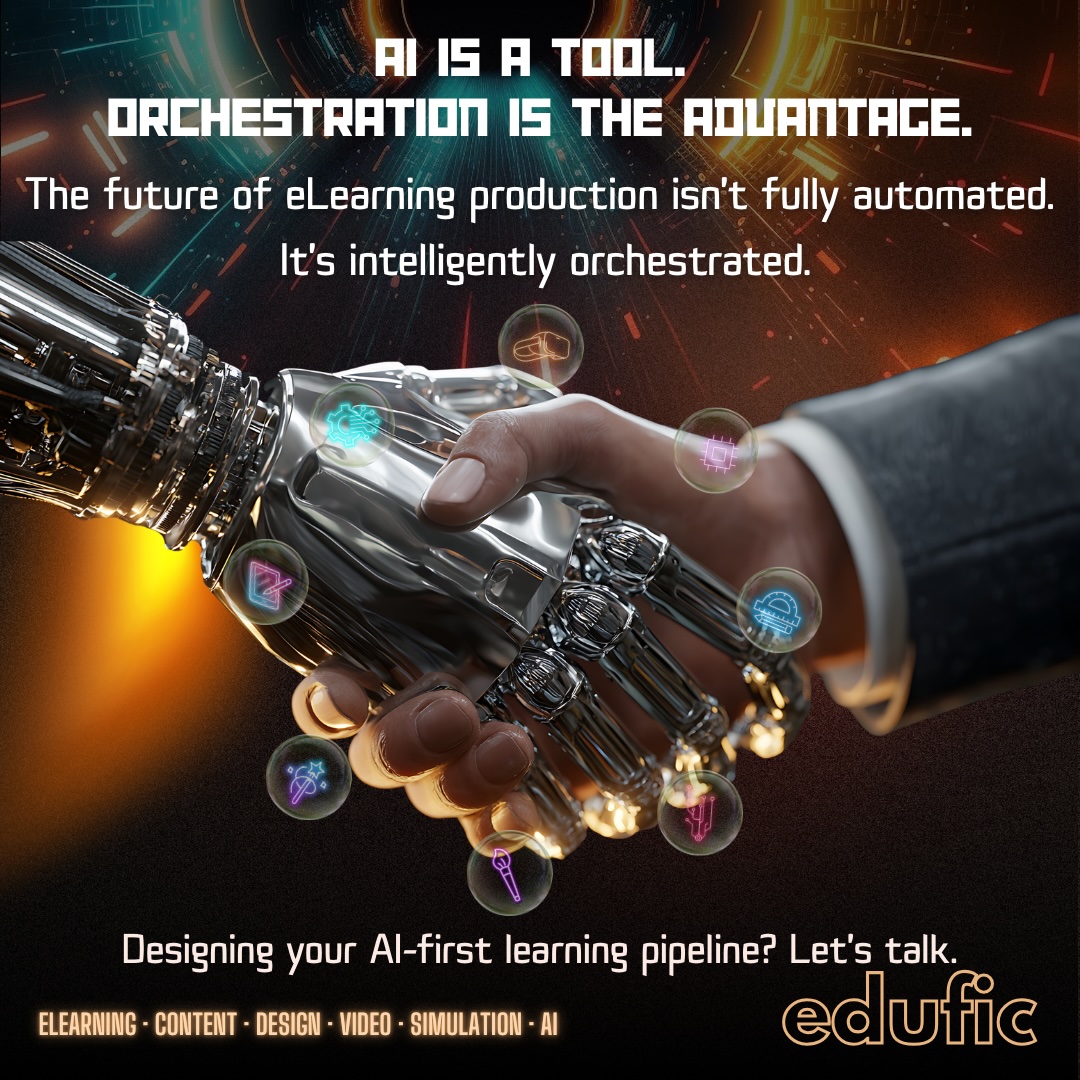
The uncomfortable truth is this: the future of eLearning production is not fully automated. It is intelligently orchestrated.
Across the industry, we are seeing learning teams move quickly to adopt AI. Script generators are getting sharper. Avatar videos are rendering faster. Media pipelines are becoming more automated than ever before. On the surface, this looks like meaningful progress.
And in many ways, it is.
But speed has a way of exposing structural weaknesses.
What often happens next is subtle but predictable. Quality begins to wobble at scale. Brand voice starts to drift across modules. Instructional intent, once carefully designed, becomes diluted as content volume increases. Review cycles grow messy. Exception handling becomes manual again.
In short, the engine gets faster, but the system around it remains fragile.
Automation, by design, is excellent at doing more of the same thing, faster. What it does not automatically guarantee is coherence, consistency, or instructional integrity across a complex learning ecosystem.
This is where many AI-first ambitions quietly stall.
In enterprise learning, automation without orchestration is like installing bullet trains on tracks designed for local traffic. The velocity is impressive. The outcomes are unpredictable.
The organisations that are quietly pulling ahead in 2026 are approaching this very differently. They are not asking, “How much more can we automate?” Instead, they are asking a more strategic question: “How intelligently can we orchestrate humans, AI, and workflow together?”
That shift in thinking is where real scale begins.
Intelligent orchestration recognises that AI is a powerful production accelerator, but not a standalone learning strategy. It requires deliberate system design around it. It requires clearly defined human checkpoints. It requires quality gates that are built into the pipeline, not added as afterthoughts. Most importantly, it requires a production architecture that can absorb volume without eroding learning effectiveness.
When this is done well, the model becomes far more resilient.
AI brings the velocity needed for modern content demand. Human judgment protects instructional integrity and brand fidelity. Structured workflows ensure repeatability and predictability. Together, they create a learning production engine that is not just fast, but trustworthy at scale.
At Edufic, this is the shift we are increasingly helping forward-looking L&D teams navigate. The conversation is evolving from tool adoption to system design. From isolated automation wins to end-to-end learning pipeline thinking. From speed as the primary metric to consistency and learning impact as the true measures of success.
Because the real competitive moat is no longer access to AI tools. Those are rapidly becoming table stakes.
The advantage now lies in how intelligently the entire learning ecosystem is orchestrated.
Organisations that recognise this early will not just produce more content. They will produce learning experiences that remain coherent, on-brand, instructionally sound, and operationally scalable — even as volumes grow.
That is what AI-first maturity actually looks like.
Not more AI noise.
Better learning architecture.