

Most learning ends quietly.
A few nods around the room.
A polite “thanks” at the end.
A checkbox ticked somewhere inside an LMS.
And then… nothing.
We’ve normalised this ending. In many organisations, silence is treated as success. If no one asks questions, if no one pushes back, if no one looks confused, we assume the learning worked. The session ran on time. The deck was covered. The completion rate looks healthy.
But silence is easy to misread.
Silence often isn’t understanding. It’s restraint. Fatigue. Habit. Sometimes it’s just politeness. People are busy. Calendars are full. Work is waiting. So they nod, thank, and move on.
Completion, too, has become a convenient illusion. Once a course is marked “done,” we feel a sense of closure. But confidence doesn’t come from finishing something. It comes from being able to use it — under pressure, without prompts, when the stakes are real.
Real learning behaves very differently.
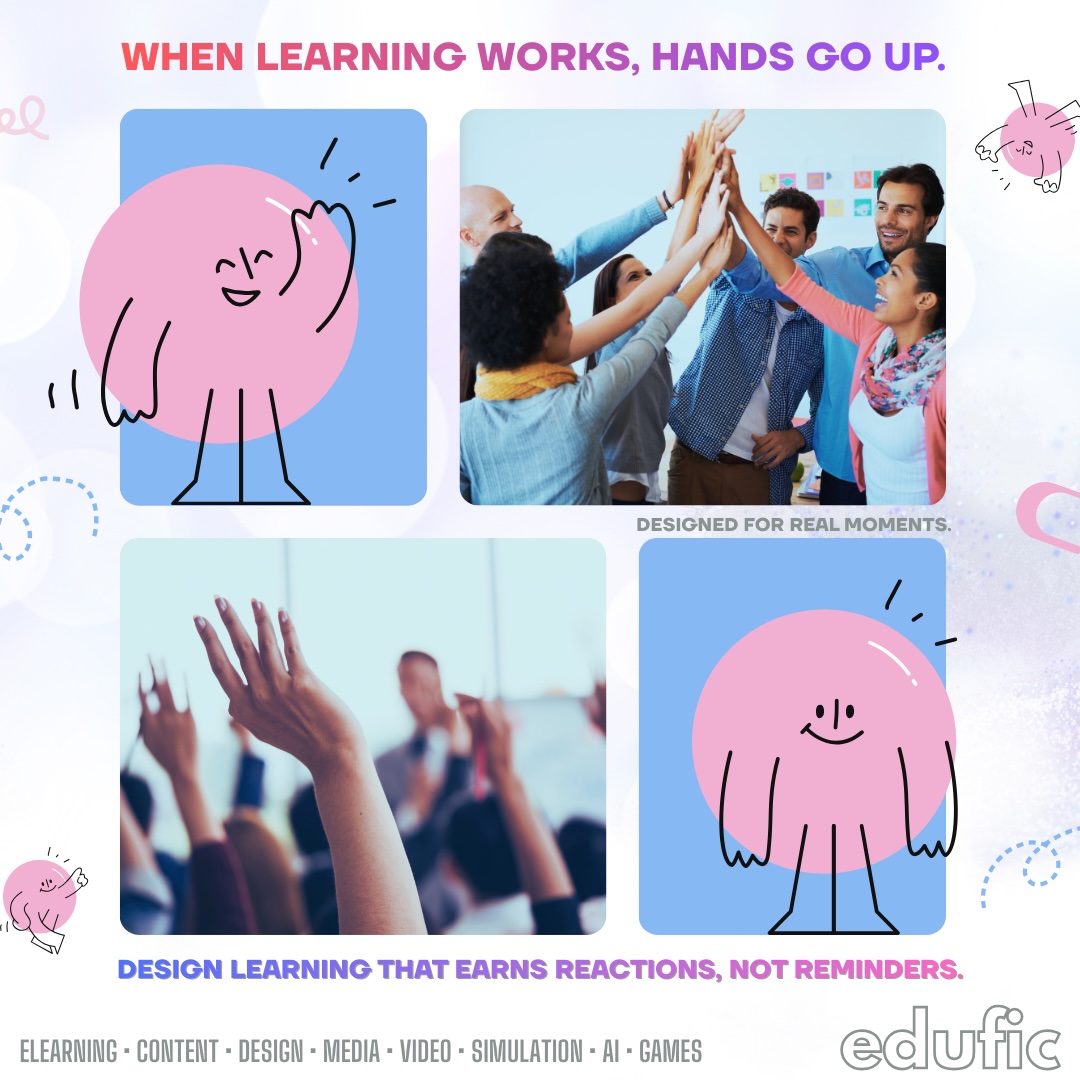
When learning actually works, hands go up.
Not because someone is lost or confused.
Not because the instructions weren’t clear.
Hands go up because people are engaged. Because something clicked. Because a concept connected to their reality. Because they want to contribute, challenge an idea, or test a decision. They’re no longer passive recipients of information. They’re participants in meaning-making.
That moment is a different kind of signal.
It’s not loud. It doesn’t announce itself with applause. It doesn’t wait for feedback forms. It shows up instinctively — in raised hands, animated discussions, sharper questions, quicker alignment.
And interestingly, this signal rarely shows up where we’re trained to look.
You won’t find it neatly captured in completion rates.
It won’t surface clearly in post-session surveys.
And it definitely won’t glow on dashboards refreshed every Monday morning.
You notice it later.
You see it in meetings where decisions move faster because people aren’t rehashing basics.
In fewer “let me check and get back” responses because someone already knows what to do.
In teams that act instead of hesitate.
In conversations that sound clearer, more confident, more grounded.
You notice it most clearly in moments where there’s no slide to hide behind — and none is needed.
That’s when learning reveals whether it worked or not.
When learning works, hands go up in rooms that matter. Rooms where work is happening live. Where pressure exists. Where trade-offs are real. Where decisions carry consequences beyond the classroom.
That’s the kind of learning we design at Edufic.
Not learning that fills calendars.
Not learning that looks impressive on paper.
Not learning that exists only inside platforms, decks, or reports.
We design learning for real moments — moments when prompts disappear and work begins. When people don’t have time to search for answers or revisit content. When they need clarity, judgment, and confidence to act.
This means rethinking what “good learning” looks like.
It’s less about coverage and more about relevance.
Less about volume and more about signal.
Less about completion and more about conviction.
Learning that works doesn’t need to be chased. It doesn’t rely on reminders, nudges, or follow-up emails begging people to engage. It earns reactions naturally, because it fits the reality people operate in.
And when that happens, something changes.
Hands don’t stay down.
They go up.
Not because someone asked for them to.
But because learning finally showed up where it was meant to — in real work, in real moments, with real impact.
That’s when learning stops being an event.
And starts becoming capability.
#CustomLearning #SeriousGames #SoftSkills #LMS #TrainingSolutions #OnlineLearning #LifelongLearning #Gamification #CorporateTraining #EdTech #GenerativeAI #ContentCreation #InstructionalDesign #OnlineCourses #EducationForAll #LearningJourney #Elearning #EduficDigital #Edufic
www.edufic.com @eduficdigital