
Learners Are Not Distracted. They Are Filtering.
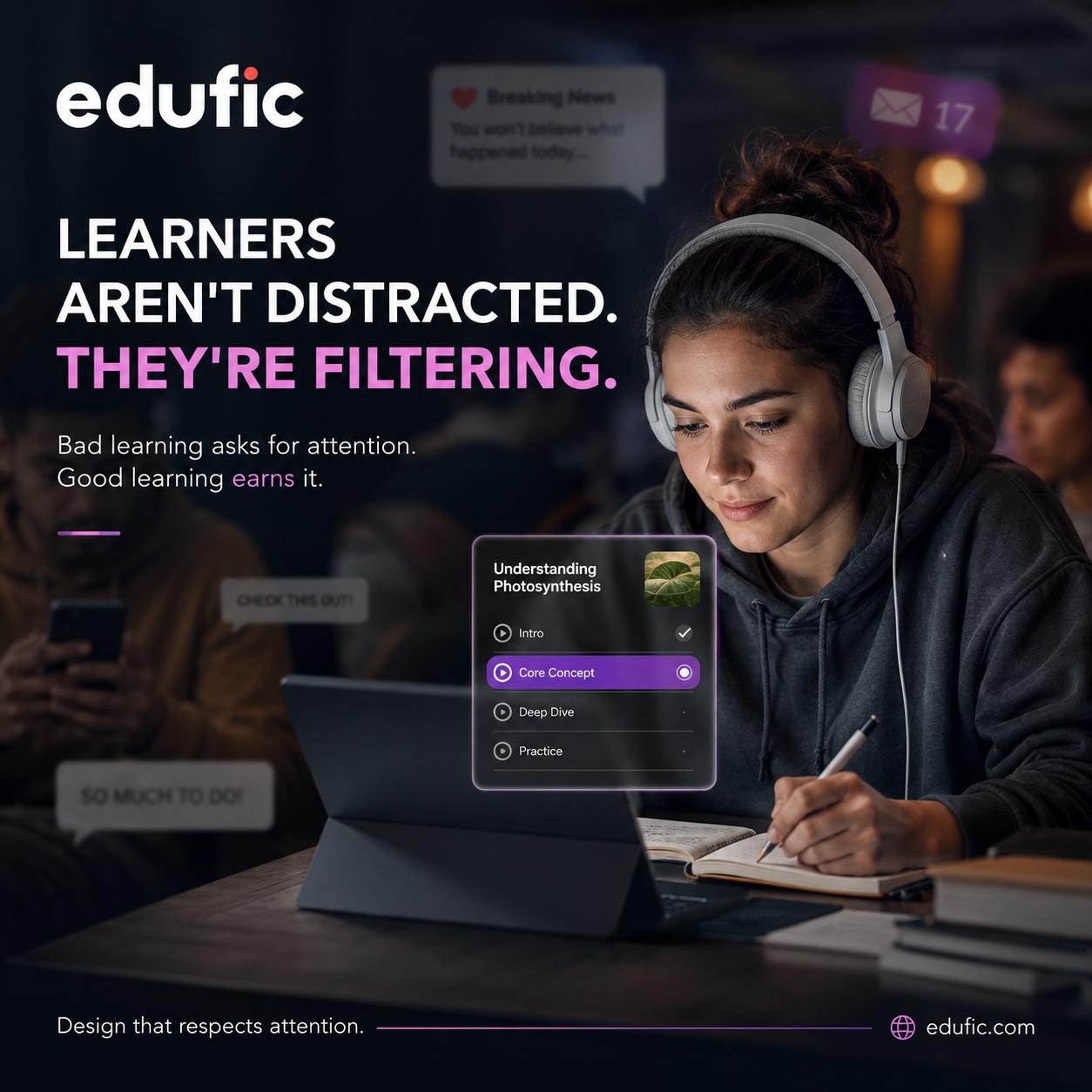
Learners are not distracted.
They are filtering.
In today’s workplace, attention is not automatic. Employees are surrounded by meetings, messages, notifications, deadlines, dashboards, tasks and competing priorities. Every day, they decide what deserves their focus and what can be ignored.
That is why digital learning cannot simply ask for attention.
It has to earn it.
A course may be mandatory. A module may be assigned. A notification may appear in the LMS. But none of that guarantees meaningful attention.
Learners engage when the learning is clear, relevant, useful and connected to their work.
At Edufic Digital, we design custom eLearning experiences that respect learner attention through strong structure, focused messaging, practical application and thoughtful learning experience design.
Because good learning does not fight for attention through noise.
It earns attention through value.
Why Learner Attention Is Harder to Earn Today
Workplace learners are busy.
They are managing emails, meetings, customer needs, internal systems, team expectations, deadlines, compliance requirements and performance pressure. In many organisations, learning happens alongside work, not away from it.
This means learners are constantly making attention decisions.
Is this useful?
Is this relevant?
Do I need this now?
Will this help me do my job?
Can I apply this?
Is this worth my time?
When a course does not answer these questions quickly, learners start filtering it out.
They may still complete the module, but their attention has already moved elsewhere.
This is why learner engagement is not simply about adding more interactivity, animation or gamification. Those elements can help, but only when they serve a clear learning purpose.
The real issue is relevance.
The Problem with Attention-Hungry Learning
Some digital learning experiences try to hold attention by adding more features.
More clicks.
More animations.
More badges.
More screens.
More pop-ups.
More narration.
More visual effects.
But more activity does not always create more engagement.
If the learning is unclear, overloaded or disconnected from work, learners will still disengage.
Attention-hungry learning often feels busy but not useful.
It asks learners to keep clicking without helping them think, decide or apply.
Good learning design does the opposite.
It reduces noise.
It helps learners focus.
It makes the next step clear.
It connects content to a real workplace need.
That is how learning earns attention.
Why Clarity Matters in eLearning
Clarity is one of the most important factors in learner engagement.
When learning is clear, learners understand where they are, why the topic matters and what they are expected to do next.
Clarity reduces cognitive load. It helps learners spend less effort figuring out the course and more effort understanding the content.
A clear eLearning course has:
A strong learning purpose
Focused objectives
Simple structure
Clean visual hierarchy
Relevant examples
Clear instructions
Meaningful interactions
Useful feedback
Practical takeaways
Clarity is not about oversimplifying learning.
It is about removing unnecessary friction.
When learners can see the value quickly, they are more likely to stay engaged.
Relevance Earns Attention
Learners pay attention when the content speaks to their work.
A compliance rule becomes more engaging when learners see how it applies to a real decision.
A process becomes easier to follow when learners see it inside their workflow.
A leadership concept becomes more meaningful when it is connected to an actual conversation.
A product feature becomes more useful when it is linked to a customer need.
Relevance helps learners answer the most important question:
Why should I care?
Custom eLearning is powerful because it can be designed around the organisation’s real context, roles, systems, processes, risks, language and performance expectations.
When learning feels familiar and practical, attention follows.
Cognitive Load and Learner Engagement
Cognitive load refers to the mental effort required to process information.
When a course is overloaded, learners spend too much energy sorting through unnecessary information. This affects attention, retention and application.
Common causes of cognitive overload include:
Too much text on screen
Too many ideas at once
Unclear flow
Visual clutter
Long explanations without examples
Generic content
Weak hierarchy
Disconnected interactions
No clear link to work
Good instructional design helps reduce cognitive load.
It organises information into a clear learning journey. It identifies what matters most. It separates essential content from reference material. It uses visuals, scenarios and examples to support understanding.
When cognitive load is reduced, learning becomes easier to follow and easier to remember.
Designing Learning That Respects Attention
Attention-respecting learning is not shorter by default.
It is sharper.
It does not waste the learner’s time. It focuses on what matters, gives context, creates flow and supports application.
This kind of learning design asks:
What does the learner need to do differently?
What information is essential?
Where might the learner get confused?
What can be removed?
What should be practised?
What should be available as a job aid?
How can the course connect to real work?
What should the learner remember after the course?
These questions help transform content into a useful learning experience.
The goal is not to make learning loud.
The goal is to make it worth the learner’s attention.
From Passive Content to Practical Application
Learners are more likely to stay engaged when they can apply what they are learning.
That is why effective digital learning should include opportunities for practice, reflection, decision-making and feedback.
This may include:
Scenario-based learning
Simulation training
Knowledge checks
Case studies
Role-based examples
Microlearning
Job aids
Performance support
Reflection prompts
Guided practice
Application makes learning active.
Instead of simply receiving information, learners connect the content to real workplace situations.
This is where attention becomes deeper.
Learners are no longer just watching or clicking.
They are thinking.
The Role of Scenario-Based Learning
Scenario-based learning helps earn attention because it creates context.
A realistic scenario places the learner inside a situation they may actually face at work. It asks them to make a choice, see a consequence and receive feedback.
This makes learning more relevant and memorable.
Scenario-based learning is especially useful for compliance training, customer service training, onboarding, leadership development, behavioural training, safety training and process learning.
Scenarios help learners filter less because the content feels immediately useful.
They can see the workplace connection.
They can understand the consequence.
They can practise before the real moment arrives.
Why Good Learning Must Be Learner-Focused
Learner-focused design begins with the learner’s reality.
It does not simply ask, “What content should we include?”
It asks:
Who is the learner?
What do they already know?
What pressure are they under?
What decisions do they need to make?
What mistakes should the learning help prevent?
What support do they need after the course?
What would make this learning useful to them?
This is the difference between content delivery and learning experience design.
A content-led course may include everything.
A learner-focused course includes what helps the learner understand, apply and perform.
Learner Engagement Is Earned, Not Assumed
Learner engagement is often treated as something a course automatically receives.
But engagement has to be earned.
It is earned through relevance.
It is earned through clarity.
It is earned through useful practice.
It is earned through thoughtful structure.
It is earned through respect for the learner’s time and context.
Bad learning asks for attention.
Good learning earns it.
How Edufic Digital Designs Learning That Earns Attention
At Edufic Digital, we create custom digital learning experiences that help organisations build clarity, relevance and application into every learning journey.
Our solutions include:
Custom eLearning development
Instructional design
Learning experience design
Scenario-based learning
Simulation training
Microlearning
Performance support
Compliance training
Onboarding training
Leadership development
Process learning
Product training
Sales training
Employee training
SCORM-ready course development
We design learning around how people actually learn and work.
Our goal is to help employees understand faster, remember what matters and apply learning with confidence.
Because in a busy workplace, attention is valuable.
Learning should respect it.
Learners Are Not Distracted. They Are Filtering.
In today’s workplace, people are constantly deciding what deserves their attention.
If learning feels irrelevant, overloaded or disconnected from work, learners will filter it out.
But when learning is clear, focused and useful, it earns attention.
At Edufic Digital, we design custom eLearning experiences that help people understand what matters, ignore the noise and stay connected to real workplace outcomes.
Edufic. Design that respects attention.
Explore custom digital learning solutions at edufic.com
#Edufic #EduficDigital #CustomELearning #DigitalLearning #CorporateLearning #LearningAndDevelopment #InstructionalDesign #LearningDesign #LearningExperienceDesign #LearnerEngagement #WorkplaceLearning #EmployeeTraining #CorporateTraining #AttentionDesign #CognitiveLoad #OnlineTraining #LearningOutcomes #CapabilityBuilding #PerformanceImprovement #LXD #FutureOfLearning
Meta Title: Learners Are Not Distracted. They Are Filtering. | Edufic Digital
Meta Description: Learn why learner engagement depends on clarity, relevance and attention design, and how custom eLearning can help employees focus, understand and apply what matters at work.
Suggested URL Slug: learners-are-filtering-attention-design-elearning