
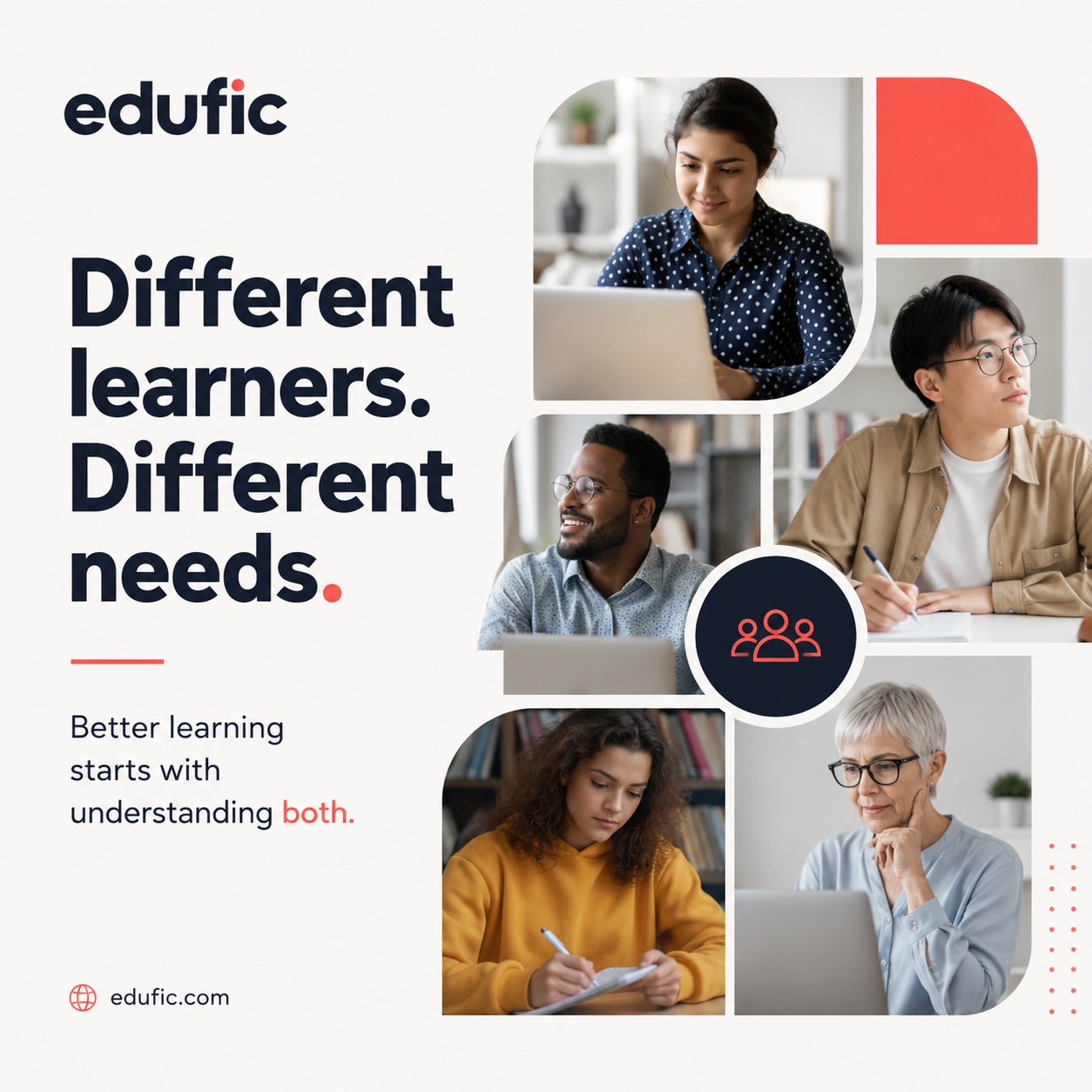

Different Learners. Different Needs. Better Learning Outcomes.
Different learners bring different roles, experiences, challenges and goals to the workplace.
Their learning should reflect that.
A new employee does not need the same learning experience as an experienced manager. A frontline team member does not learn in the same context as a corporate function leader. A sales employee, operations executive, customer service representative, compliance learner and team manager may all need to understand the same organisation, but they need different routes into the learning.
That is why effective corporate training does not begin with content.
It begins with understanding the learner.
At Edufic, we design custom eLearning and digital learning experiences around the people who will actually use them. From new employees and frontline teams to managers and experienced professionals, every solution is shaped by the learner’s context, role and desired performance outcome.
Because better learning outcomes come from better learner understanding.
Why One-Size-Fits-All Training Falls Short
Many corporate training programmes are designed around content first.
The organisation has a policy to explain, a process to introduce, a product to train, a system to roll out or a behaviour to reinforce. The content is collected, structured and converted into a course.
But when the learning experience does not reflect the learner’s role, context or challenge, it can feel generic.
Learners may complete the course, but they may not see how it applies to them.
A frontline employee may need quick, practical guidance.
A manager may need decision-making practice.
A new hire may need orientation and confidence.
An experienced professional may need advanced scenarios.
A sales team may need customer conversation practice.
A compliance learner may need realistic judgement-based situations.
When all these learners receive the same experience, the learning may become too broad to be useful.
Custom eLearning helps solve this by designing learning around the learner, not just the source content.
What Learner-Centric Design Means
Learner-centric design means creating learning experiences that reflect how people actually learn, work and apply knowledge.
It asks important questions before the course is designed:
Who is the learner?
What role do they play?
What do they already know?
What challenges do they face at work?
What decisions do they need to make?
What mistakes should the learning help prevent?
What should they be able to do after the learning?
What support do they need after the course?
What business outcome should the learning support?
These questions help shape the learning experience.
Instead of creating one generic course for everyone, learner-centric design creates learning that feels relevant, practical and useful.
The Role of Context in Workplace Learning
Context is what makes learning meaningful.
When learners can see their own work inside the learning experience, they are more likely to pay attention, remember the message and apply it.
For example, compliance training becomes more effective when it uses realistic workplace dilemmas. Process training becomes clearer when it follows the learner’s actual workflow. Leadership training becomes stronger when it reflects real conversations managers face. Product training becomes more useful when it connects to customer needs.
Context helps learners answer a key question:
Why does this matter to me?
When that question is answered clearly, engagement improves.
Learning for New Employees
New employees need clarity, confidence and direction.
Onboarding should not simply introduce policies, departments and systems. It should help new hires understand the organisation, their role, the culture, key expectations and how to begin contributing.
Custom onboarding eLearning can include welcome journeys, leadership messages, role-based pathways, process explainers, interactive scenarios, team culture modules, system introductions and manager support tools.
The goal is to help new employees feel ready, not just informed.
Good onboarding helps reduce confusion, improve early confidence and support faster time to productivity.
Learning for Frontline Teams
Frontline teams often need learning that is practical, accessible and directly connected to daily work.
They may not have long uninterrupted learning time. They may need quick guidance, simple process steps, customer response practice, safety reminders or mobile-friendly learning assets.
For frontline learning, formats such as microlearning, short videos, job aids, mobile learning, simulations and quick reference tools can be especially useful.
The learning must be close to the work.
It should help employees act with confidence when the moment arrives.
Learning for Managers
Managers need learning that prepares them for decisions, conversations and people challenges.
Leadership and manager training should go beyond theory. It should help managers practise real workplace moments such as giving feedback, handling conflict, coaching team members, setting expectations, supporting change and managing performance.
Scenario-based learning, branching conversations, video-led learning, reflection prompts and manager toolkits can help managers build confidence.
For managers, learning should not only explain leadership principles.
It should help them use those principles when the situation becomes real.
Learning for Experienced Professionals
Experienced learners do not always need basic explanations.
They may need advanced application, complex scenarios, decision-making practice, updated knowledge, role-specific challenges and opportunities to refine judgement.
For this group, learning can be more focused on nuance, exceptions, problem-solving and performance improvement.
Custom digital learning can support experienced professionals through advanced simulations, case-based learning, scenario libraries, expert-led microlearning, peer learning prompts and performance support.
The aim is to respect their existing expertise while helping them deepen or update capability.
Why Role-Based Learning Improves Relevance
Role-based learning makes corporate training more useful because it connects the content to what each learner actually does.
A customer service learner may need to practise responses and escalation decisions.
A sales learner may need product positioning and objection handling.
A compliance learner may need judgement-based scenarios.
A process learner may need workflow practice.
A leader may need coaching and feedback simulations.
A system user may need task-based walkthroughs.
The same topic can be designed differently for different roles.
That is the strength of custom eLearning.
It allows the learning experience to fit the learner’s world.
Instructional Design for Different Learner Needs
Instructional design plays a critical role in creating learner-centric digital learning.
It helps translate content into a structured learning journey based on learner needs, performance goals and workplace context.
Strong instructional design helps decide:
What content is essential
What content can become reference material
What examples are most relevant
Where learners need practice
Where scenarios should be used
What feedback will help learners improve
How the learning should be sequenced
How the course should be assessed
How performance should be supported after the course
Without instructional design, custom eLearning can become a digital content dump.
With strong instructional design, the learning becomes focused, clear and useful.
Simulations and Scenario-Based Learning
Simulations and scenario-based learning are valuable because they allow learners to practise in context.
A simulation helps learners try a process, system or workflow in a safe environment.
A scenario helps learners make decisions, explore consequences and receive feedback.
These formats are especially useful when the learning goal is application, judgement or confidence.
For different learner groups, scenarios and simulations can be adapted to reflect role-specific realities.
For example:
A manager can practise a difficult conversation.
A frontline employee can respond to a customer issue.
A compliance learner can identify a risky situation.
A system user can practise a workflow.
A sales learner can choose a response to an objection.
This helps learners move from knowing to doing.
Microlearning for Different Learning Moments
Microlearning is useful when learners need short, focused learning support.
It can be used for refreshers, quick guides, key concept reinforcement, performance support, pre-work, post-training follow-up or just-in-time learning.
Different learner groups can benefit from microlearning in different ways.
New employees may use it to reinforce onboarding topics.
Frontline teams may use it during work.
Managers may use it before conversations.
Experienced professionals may use it to refresh complex concepts.
Sales teams may use it before customer meetings.
Microlearning works best when it is designed around a specific task, decision or learning moment.
Learning Videos and Digital Learning Experiences
Learning videos can help explain concepts, demonstrate behaviours, introduce scenarios and make complex topics easier to understand.
But video should not be used only for presentation. It should support the learning goal.
A video for new hires may create emotional connection. A video for managers may demonstrate a conversation. A video for process training may explain a workflow. A video for compliance may show a realistic dilemma.
At Edufic, learning videos are designed as part of a larger digital learning experience, not as standalone content pieces.
The goal is to support understanding, retention and application.
Localisation and Learning Across Regions
Organisations with distributed teams often need learning across regions and languages.
Localisation is not only translation.
It is about making learning accessible, understandable and culturally relevant for different learner groups.
Custom eLearning can be adapted for different languages, examples, regions, roles and contexts while keeping the core learning objective consistent.
This is especially important for global organisations, multilingual teams and large-scale corporate training programmes.
Learning becomes more effective when learners can understand it clearly in their own context.
Better Learning Outcomes Start with the Learner
When learning begins with the learner, the experience becomes more relevant.
Relevant learning improves attention.
Clear learning improves understanding.
Contextual learning improves application.
Practice-based learning improves confidence.
Role-based learning improves performance.
This is why learner-centric design is important for corporate learning.
The goal is not to create one course that covers everything.
The goal is to create the right learning experience for the right audience.
How Edufic Designs Learner-Centric Digital Learning
At Edufic, we design custom eLearning and digital learning experiences around learner needs, workplace context and performance outcomes.
Our solutions include:
Custom eLearning development
Instructional design
Simulations
Scenario-based learning
Learning videos
Microlearning
Mobile learning
Localisation
Compliance training
Onboarding training
Leadership development
Process training
Product training
Sales training
Capability development
SCORM-ready digital courses
We work with organisations to understand their learners, simplify content, create meaningful learning journeys and support real workplace application.
Because effective learning starts with people.
Different Learners. Different Needs. Better Learning Outcomes.
Different learners bring different roles, experiences, challenges and goals to the workplace.
Their learning should reflect that.
At Edufic, we create custom digital learning experiences shaped around the learner’s context, role and desired performance outcome.
Because effective corporate training does not begin with content.
It begins with understanding the learner.
Different learners.
Different needs.
Better learning outcomes.
Explore Edufic’s custom eLearning, instructional design, simulations, learning videos, microlearning and localisation solutions at edufic.com
#Edufic #CustomELearning #DigitalLearning #CorporateTraining #InstructionalDesign #LearnerCentricDesign #WorkplaceLearning #LearningExperienceDesign #EmployeeTraining #LearningAndDevelopment
Meta Title: Different Learners, Different Needs: Why Learner-Centric eLearning Works
Meta Description: Learn why effective corporate training begins with understanding the learner and how Edufic designs custom eLearning, simulations, microlearning and digital learning experiences for different roles, contexts and performance goals.
Suggested URL Slug: learner-centric-custom-elearning-different-needs