

Completion Isn’t Capability: Why Real Learning Improves Work
Course completion is easy to measure.
Capability is what changes performance.
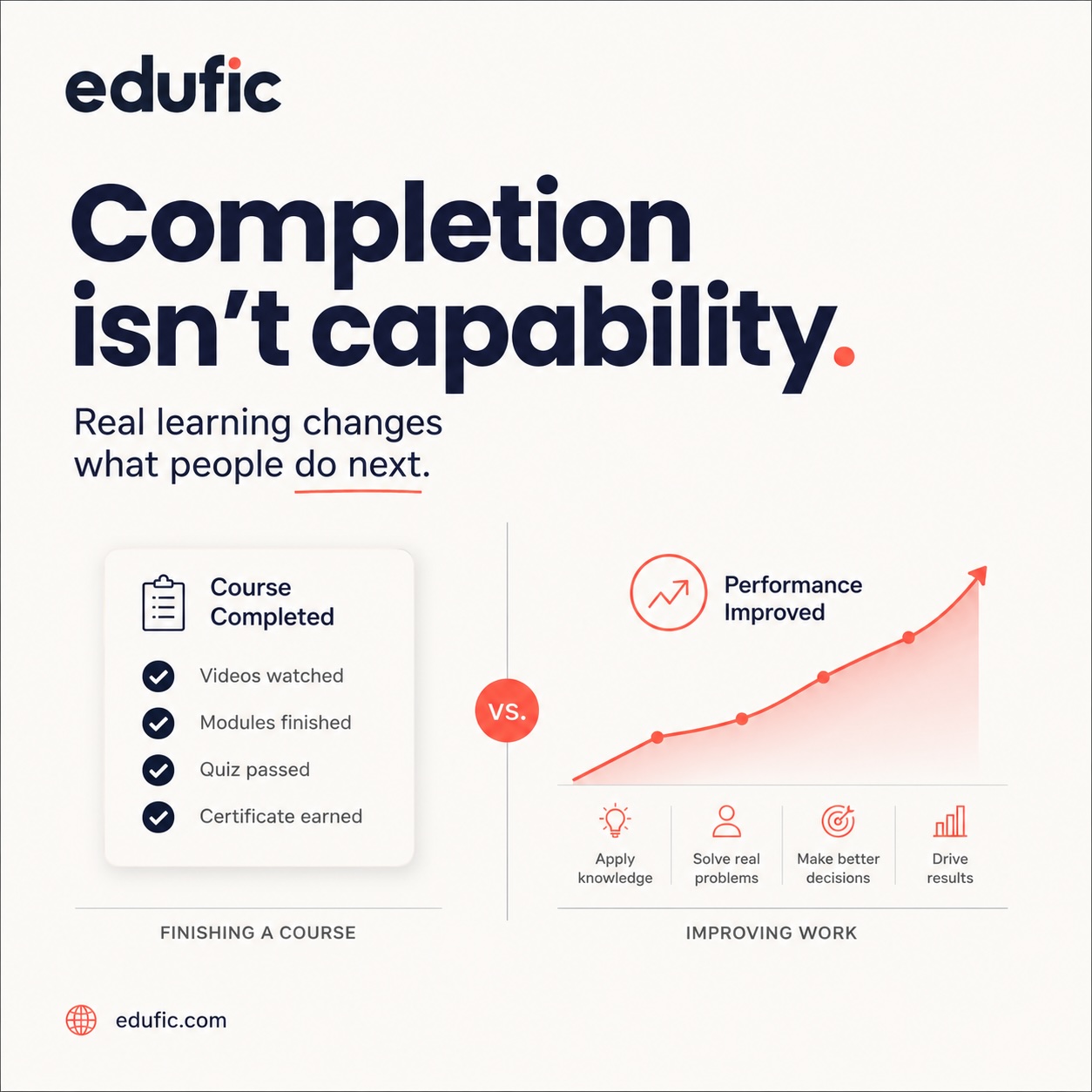
In many organisations, learning success is still measured through visible activity. Employees watch videos, complete modules, pass quizzes, earn certificates and appear in LMS reports.
These measures are useful.
They tell us whether learning was delivered and completed.
But they do not always tell us whether learning worked.
A course can be completed without changing behaviour. A quiz can be passed without improving judgement. A certificate can be earned without increasing workplace confidence.
That is why effective corporate training must go beyond completion.
The real measure of learning is what people can do differently afterwards.
Why Completion Is Not Enough
Completion is one of the most common metrics in corporate training because it is easy to track.
An LMS can show who enrolled, who completed, who passed, who failed and who is overdue. For compliance training, onboarding, mandatory learning and enterprise-wide rollouts, this data is important.
But completion data has limits.
It does not always show whether employees can apply knowledge in real situations.
It does not prove that they can solve workplace problems.
It does not confirm that they can make better decisions.
It does not show whether confidence has improved.
It does not always connect learning to measurable business outcomes.
Completion tells us that a learner reached the end of a course.
Capability tells us whether the learner is more ready to perform.
What Capability Means in Corporate Learning
Capability is the ability to use knowledge, skill and judgement in real work situations.
It is not only about remembering information.
It is about applying that information when the situation matters.
Capability shows up when employees can follow a process correctly, respond to a customer confidently, use a system accurately, make a compliant decision, solve a workplace problem or lead a conversation with clarity.
In other words, capability is visible in action.
That is why corporate learning should be designed around what people need to do, not simply what they need to know.
The Gap Between Knowing and Doing
Many training programmes focus heavily on knowledge transfer.
They explain the policy. They describe the process. They introduce the system. They define the behaviour. They present the product. They test recall.
This is useful, but it is only the beginning.
Employees also need to know how to use that knowledge at work.
For example:
A compliance learner needs to recognise risk and make the right decision.
A new hire needs to understand how to perform in the role.
A manager needs to handle difficult conversations.
A sales employee needs to respond to customer needs.
A process user needs to follow the workflow correctly.
A technician needs to take the right action at the right moment.
The gap between knowing and doing is where learning design matters most.
Custom eLearning Built Around Real Work
Custom eLearning is effective because it can be built around the organisation’s specific context, goals, roles and performance expectations.
Generic learning may explain a topic.
Custom learning can connect that topic to the learner’s real work.
At Edufic, we design custom eLearning experiences around what people need to do after the learning is complete. This means understanding the learner, the task, the workplace context and the desired performance outcome.
The goal is not just to create a course.
The goal is to build capability.
How Digital Learning Can Improve Performance
Performance-focused digital learning uses the right combination of structure, clarity, practice and feedback.
It helps learners understand what matters, apply knowledge in context and build confidence before the real situation arrives.
This may include:
Custom eLearning modules
Scenario-based learning
Simulation training
Microlearning
Learning videos
Knowledge checks with meaningful feedback
Performance support tools
Role-based learning paths
Process walkthroughs
Manager reinforcement assets
Each format serves a different purpose. The right design depends on what learners need to do differently at work.
Scenario-Based Learning for Better Decisions
Scenario-based learning helps learners practise workplace judgement.
Instead of only asking learners to recall information, scenarios place them in realistic situations and ask them to make choices.
This is useful because real work often involves ambiguity, pressure and consequences.
A scenario can help learners practise customer conversations, compliance decisions, leadership moments, safety choices, process exceptions and behavioural responses.
When learners practise decisions before the real moment, they are more likely to act with confidence when the situation appears at work.
Simulation Training for Practical Application
Simulation training helps employees practise systems, processes and workflows in a safe environment.
This is especially valuable when mistakes in real work can be costly, time-consuming or risky.
Simulations allow learners to try the steps, make decisions, receive feedback and build confidence before using the actual system or process.
A demonstration shows learners what to do.
A simulation lets them do it.
That difference is important when the goal is workplace performance.
Microlearning for Reinforcement and Recall
Microlearning can help employees access short, focused learning at the right time.
It works well for refreshers, key concept reinforcement, process reminders, compliance nudges, product updates and performance support.
When microlearning is designed well, it does not overload learners. It gives them the right information at the right moment.
This supports retention and application.
It also helps bridge the gap between formal training and day-to-day work.
Learning Videos That Support Understanding
Learning videos can help simplify complex ideas, demonstrate behaviours and show real-world situations.
But video should not be used only to make training look polished.
It should support a clear learning goal.
A strong learning video can help explain a process, model a conversation, introduce a scenario, demonstrate a skill or create context for a topic.
When combined with interaction, reflection or practice, learning videos can support stronger retention and application.
Measuring What Matters
If the goal is capability, then measurement must go beyond completion.
Completion can remain one metric, but it should not be the only one.
Organisations can also look at:
Assessment performance
Scenario choices
Simulation scores
Learner confidence
Manager feedback
Workplace application
Process accuracy
Error reduction
Time to proficiency
Customer experience indicators
Compliance behaviour
Sales or service outcomes
Operational performance
The right measure depends on the training goal.
The important shift is to ask what changed after the course.
From Content Delivery to Performance Learning
Performance learning begins with the outcome.
Instead of asking, “What content should we include?” it asks, “What should people be able to do?”
This changes the learning design process.
It helps identify what content is essential, what can become reference material, where learners need practice, where feedback is required and how learning should be reinforced after completion.
This approach makes learning more useful.
It also helps L&D teams connect training to business value.
Why Workplace Context Matters
Learning becomes stronger when it reflects the learner’s real context.
A process course should reflect the actual workflow.
A compliance course should include realistic dilemmas.
A leadership course should include real conversations.
A sales course should reflect customer needs.
A product course should connect features to use cases.
A safety course should show actual risks and responses.
Context helps learners understand why the learning matters and how to apply it.
Without context, training can feel abstract.
With context, learning becomes practical.
How Edufic Designs Performance-Focused Learning
At Edufic, we design custom eLearning and digital learning experiences around what people need to do, not simply what they need to know.
Our solutions include:
Custom eLearning development
Instructional design
Simulation training
Microlearning
Learning videos
Scenario-based learning
Compliance training
Onboarding training
Leadership development
Process training
Product training
Sales training
Performance support
SCORM-ready digital courses
We help organisations transform training content into clear, practical and performance-focused learning experiences.
Our focus is to help learners apply knowledge, solve problems, make better decisions and perform with greater confidence.
Completion Isn’t Capability
Watching videos, finishing modules, passing quizzes and earning certificates may show that learning was completed.
But effective corporate training goes further.
It helps employees apply knowledge in real situations, solve workplace problems, make better decisions, perform with greater confidence and deliver measurable business outcomes.
Because the real measure of learning is not whether someone finished a course.
It is what they can do differently afterwards.
Completion isn’t capability.
Real learning improves work.
Explore custom eLearning, simulations, microlearning, learning videos and performance-focused training solutions at edufic.com
#Edufic #CustomELearning #CorporateTraining #DigitalLearning #WorkplaceLearning #InstructionalDesign #LearningAndDevelopment #EmployeeTraining #PerformanceLearning #LearningOutcomes
Meta Title: Completion Isn’t Capability: Why Real Learning Improves Work
Meta Description: Learn why course completion is not enough and how custom eLearning, simulations, microlearning and performance-focused digital learning help employees apply knowledge and improve workplace outcomes.
Suggested URL Slug: completion-isnt-capability-real-learning-improves-work