
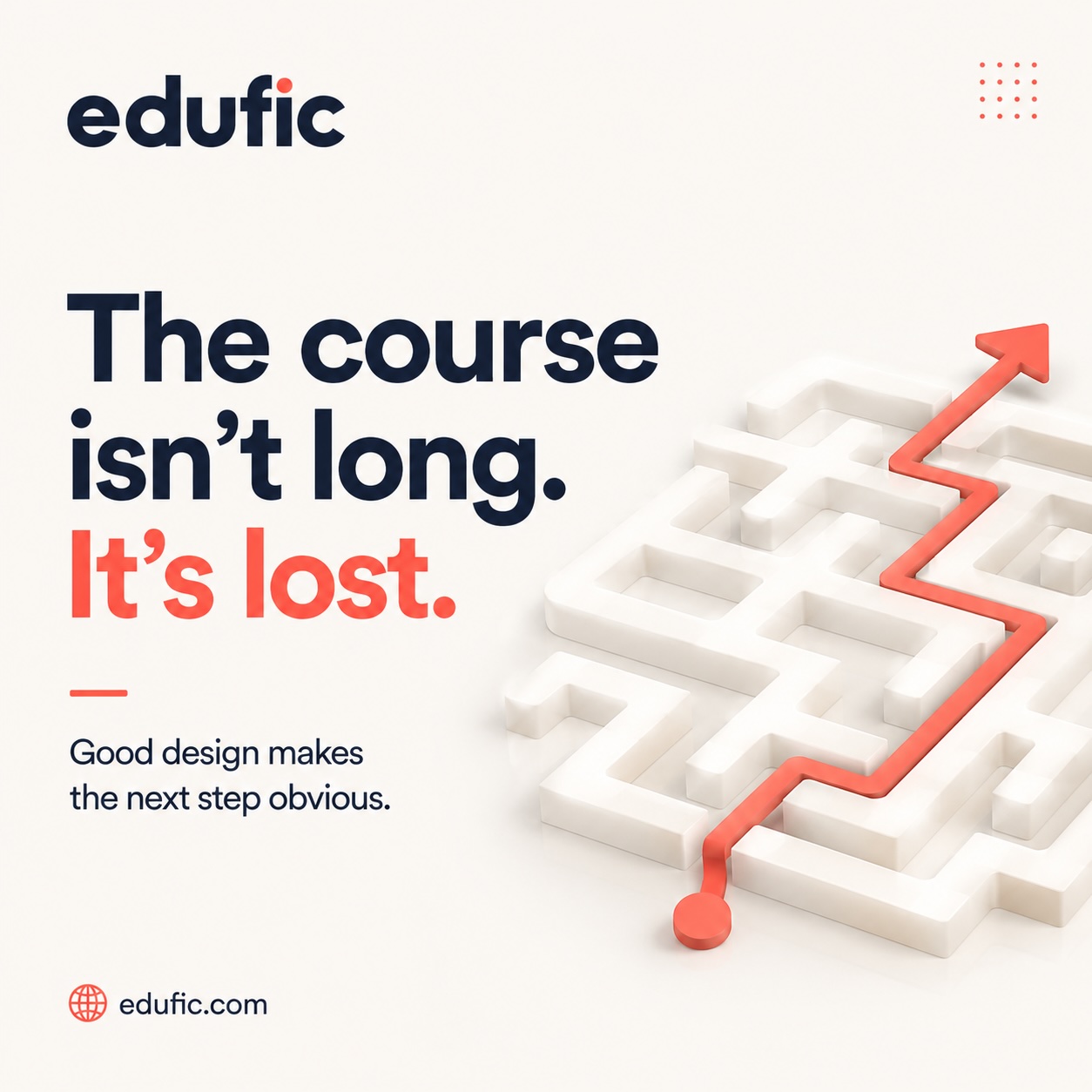

The Course Isn’t Long. It’s Lost.
When learners drop off midway through an eLearning course, the first reaction is often to make the course shorter.
Reduce the screens.
Cut the narration.
Remove some examples.
Compress the content.
Make it faster to complete.
Sometimes that helps.
But duration is not always the real problem.
A course can be short and still feel exhausting. A course can be longer and still feel useful, engaging and easy to follow.
The difference is design.
Often, learners do not drop off because the course is too long. They drop off because the course feels lost.
They are not sure where they are, what matters, why they are learning something, or what they are expected to do next.
That is where learning design makes the difference.
Good eLearning design makes the next step obvious.
Why Learners Drop Off
Learner drop-off is a common challenge in corporate eLearning.
Employees begin a course with the intention to complete it. But as the screens progress, attention fades. They begin scanning instead of learning. They click through quickly. They may finish the module, but the learning does not fully land.
This is not always because the topic is unimportant.
It often happens because the learning journey is unclear.
Learners may be asking:
Where am I in this course?
Why am I learning this now?
What should I focus on?
How does this connect to my role?
What do I need to remember?
What should I do next?
How will I use this at work?
When these questions remain unanswered, even useful content becomes tiring.
The course feels longer than it is because the learner is working too hard to make sense of it.
Course Length Is Not the Only Problem
Course duration matters, but it is not the only factor that affects learner engagement.
A 10-minute module can feel long if it is cluttered, confusing or poorly sequenced.
A 45-minute learning journey can feel valuable if it has structure, relevance, rhythm and purpose.
Learners are more likely to stay engaged when the course gives them a clear path.
They need to know what they are learning, why it matters and how it connects to the work they do.
When that path is missing, reducing the course length may not solve the problem.
The issue is not time.
The issue is direction.
The Difference Between Content and Learning
Many eLearning courses begin with strong source content.
There may be PowerPoint decks, policy documents, process guides, SME notes, product manuals, system screenshots and reference material.
But content is not the same as learning.
Content provides information.
Learning helps people understand, remember and apply that information.
A course that simply transfers content onto screens can quickly become overwhelming. Every detail may be included, but the learner may still struggle to identify what matters.
Good instructional design transforms content into a learning journey.
It decides what should be explained, what should be simplified, what should be practised, what should be reinforced and what can remain as reference material.
Without that design thinking, a course may be complete but not clear.
Why Clarity Matters in eLearning
Clarity is one of the most important qualities of effective digital learning.
When learning is clear, learners know what to focus on. They understand the flow. They can connect ideas. They feel less overwhelmed.
Clarity reduces cognitive load.
It allows learners to spend their mental energy understanding the content instead of trying to figure out the course structure.
Clear eLearning includes:
Focused learning objectives
Simple screen structure
Logical sequencing
Clean visual hierarchy
Relevant examples
Clear instructions
Meaningful interactions
Useful feedback
Strong summaries
Practical takeaways
Clarity does not mean oversimplifying the subject.
It means making the learning easier to navigate.
Flow Keeps Learners Moving
Flow is what turns a set of screens into a learning experience.
Without flow, learners move through disconnected information.
With flow, they move through a clear journey.
Good flow introduces the right idea at the right time. It gives context before detail. It uses examples before practice. It creates a smooth path from awareness to understanding, and from understanding to application.
A course with strong flow helps learners feel oriented.
They know where they are.
They know why the next section matters.
They know how one idea connects to another.
This improves attention, completion and retention.
Good Design Makes the Next Step Obvious
The image says it clearly: good design makes the next step obvious.
That is one of the most important principles of learning experience design.
Learners should not have to guess what matters.
They should not have to search for the learning path.
They should not have to work hard to understand what the course is asking them to do.
Good design guides them.
It creates a visible route through the content.
It helps them move forward with confidence.
This applies to every type of corporate learning, including compliance training, onboarding, process training, leadership development, product training, sales training, system training and capability-building programmes.
Why Visual Design Supports Learning
Visual design in eLearning is not decoration.
It is part of the learning experience.
Good visual design helps learners understand faster. It creates hierarchy, directs attention and makes complex content easier to process.
A well-designed screen can show learners:
What is most important
What comes next
What needs action
What is supporting information
What is a key takeaway
How ideas are connected
When visual design is weak, the course can feel cluttered or confusing.
When visual design is strong, the learning feels easier to follow.
Reducing Cognitive Load
Cognitive load increases when learners are presented with too much information, unclear structure or unnecessary complexity.
In workplace learning, this is a major issue because employees are already managing tasks, meetings, deadlines, systems and performance pressure.
A course should not add more confusion.
It should reduce it.
Good instructional design reduces cognitive load by organising information clearly, removing unnecessary clutter and helping learners focus on what they need to know and do.
This leads to better understanding, stronger retention and improved workplace application.
From Information to Action
The goal of eLearning is not just to present information.
The goal is to help learners act.
They should leave the course knowing what to do differently, how to apply the learning and why it matters in their role.
This is why effective digital learning often includes:
Scenario-based learning
Simulations
Practice activities
Knowledge checks
Reflection prompts
Microlearning
Performance support
Job aids
Role-based examples
These elements help learners move from passive content consumption to active application.
When learners can see how the content applies to real work, the learning becomes more meaningful.
How Edufic Designs Clearer Learning Journeys
At Edufic, we design custom eLearning and digital learning experiences that help learners move with clarity.
Our approach focuses on understanding the learner, the business goal, the source content and the performance outcome.
We help organisations simplify complex content, improve course flow, reduce cognitive load and create meaningful learning journeys.
Our services include:
Custom eLearning development
Instructional design
Learning experience design
Scenario-based learning
Simulation training
Microlearning
Onboarding training
Compliance training
Leadership development
Process training
Product training
Learning videos
SCORM-ready digital courses
The goal is not just to build courses.
The goal is to design learning that people can understand, remember and use.
Better Design Improves Learning Outcomes
Better design improves learning because it respects the learner’s attention.
It removes friction.
It creates direction.
It improves flow.
It makes the next step obvious.
It helps learners focus on what matters.
When learning is designed well, learners are more likely to complete the course with understanding, not just compliance.
They are more likely to remember the content.
They are more likely to apply it at work.
That is the real value of strong eLearning design.
The Course Isn’t Long. It’s Lost.
When learners say a course is too long, it may be worth looking deeper.
Maybe the course is not too long.
Maybe the course is unclear.
Maybe the learner is not bored.
Maybe the learner is disoriented.
Maybe the solution is not only to shorten the course.
Maybe the solution is to design a better learning path.
Because good learning design makes the next step obvious.
At Edufic, we create custom digital learning experiences that simplify complexity, improve flow and help learners move from information to action.
Explore custom eLearning and learning experience design solutions at edufic.com
#Edufic #CustomELearning #DigitalLearning #LearningDesign #InstructionalDesign #LearningExperienceDesign #CorporateLearning #LearningAndDevelopment #WorkplaceLearning #EmployeeTraining #LearnerEngagement #CognitiveLoad #TrainingDesign #OnlineLearning #CorporateTraining #PerformanceImprovement
Meta Title: The Course Isn’t Long. It’s Lost. Why eLearning Design Matters
Meta Description: Learn why learner drop-off is not always caused by course length and how better eLearning design, structure, flow and clarity improve engagement and learning outcomes.
Suggested URL Slug: course-isnt-long-its-lost-elearning-design