
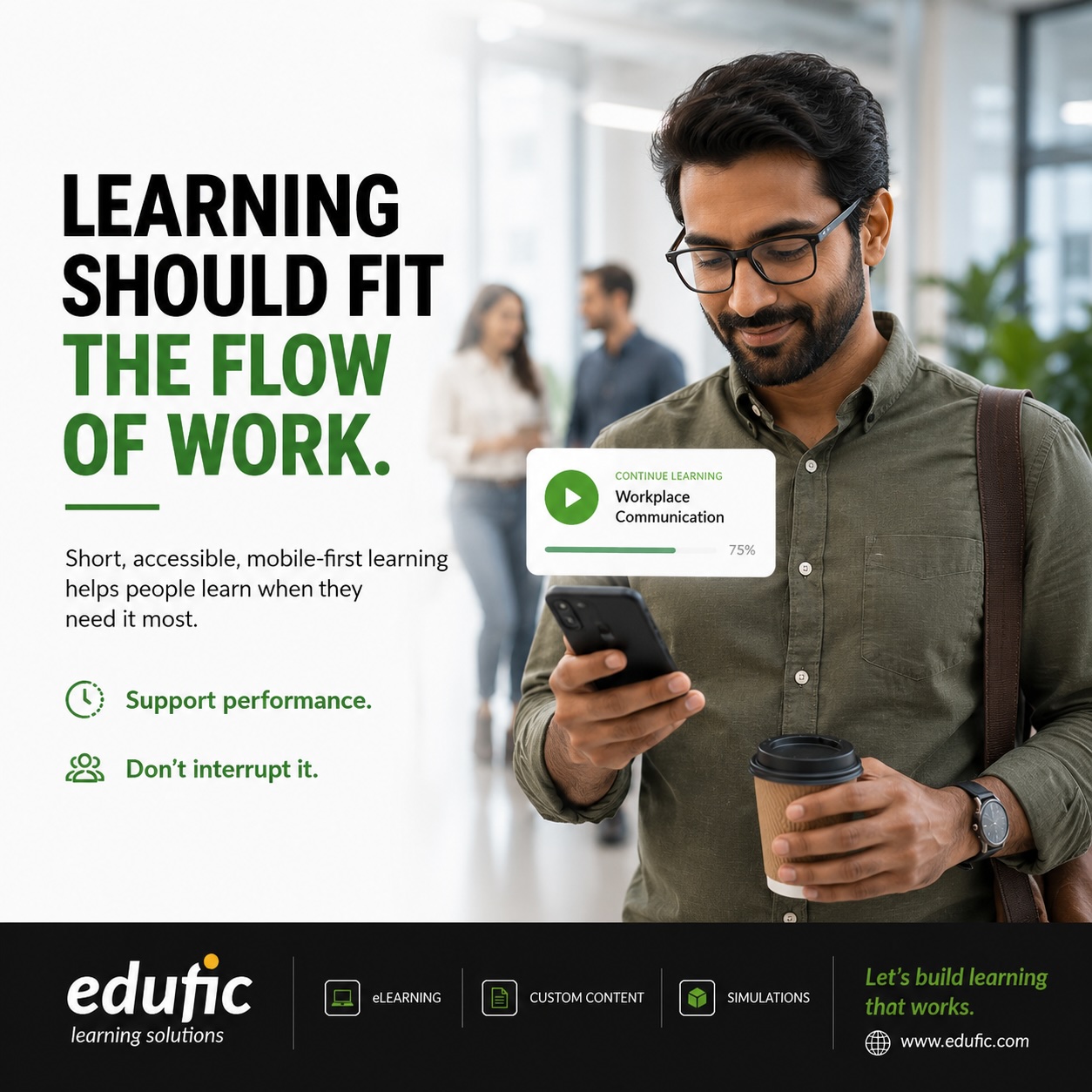

Description: Discover why modern corporate eLearning, microlearning and mobile-first learning should fit into the flow of work to improve performance, retention and workplace application.
Learning Should Fit the Flow of Work
Corporate learning is changing.
Today’s employees are busy, mobile, distracted and constantly solving problems in real time. They do not always have the time, space or patience to pause their work, sit through a long course and then remember the information later when they need it.
This is why learning should fit the flow of work.
For modern organisations, effective learning is not just about delivering content. It is about helping people perform better at the moment of need. It is about giving employees the right knowledge, in the right format, at the right time, so they can apply it directly to their work.
When learning fits naturally into the workday, it stops feeling like an interruption.
It becomes support.
Why Traditional Corporate Training Often Falls Short
Traditional corporate training often depends on scheduled sessions, long eLearning modules, classroom workshops or lengthy learning programmes. These formats still have value, especially for deep learning, leadership development, compliance training, onboarding and complex skill-building.
But not every learning need requires a long course.
Sometimes, employees need a quick refresher before a customer call. Sometimes, they need a short process guide before using a new system. Sometimes, they need a scenario-based example before handling a workplace decision. Sometimes, they need a checklist, a short video, a simulation or a mobile learning nugget that helps them act with confidence.
When every learning need is treated like a full-length training programme, learning becomes heavy.
Employees may complete the course, but they may not apply the knowledge when it matters.
The goal of corporate learning should not be completion alone. The goal should be performance.
What Is Learning in the Flow of Work?
Learning in the flow of work means making learning available within the employee’s natural work environment.
It means employees do not have to move too far away from their tasks to access useful guidance. They can learn, apply and continue working with minimum disruption.
This could include:
Short microlearning modules
Mobile-first learning content
Quick reference guides
Scenario-based learning
Process walkthroughs
Software simulations
Performance support tools
Short explainer videos
Job aids and checklists
Just-in-time learning resources
Role-based learning paths
The idea is simple.
Learning should be easy to access, easy to understand and easy to apply.
When employees get learning support at the right moment, they are more likely to use it. More importantly, they are more likely to remember it because it is connected to a real task.
Why Microlearning Works for Busy Teams
Microlearning is one of the most effective ways to support learning in the flow of work.
Instead of overwhelming learners with too much information at once, microlearning breaks content into short, focused learning units. Each unit usually addresses one concept, one skill, one behaviour or one workplace action.
This makes microlearning useful for corporate training because it respects the learner’s time and attention.
A strong microlearning experience is:
Short
Focused
Relevant
Easy to access
Designed for application
Connected to real work
For example, a sales employee may not need a 60-minute module before every customer conversation. They may need a 3-minute refresher on objection handling.
A customer support executive may not need to revisit an entire process manual. They may need a quick decision guide.
A manager may not need a long leadership course before every conversation. They may need a short scenario on giving feedback.
Microlearning works because it provides help when the learner is ready to use it.
Mobile Learning Makes Training More Accessible
Work does not happen only at desks anymore.
Employees work from offices, homes, branches, factories, stores, warehouses, airports, field locations and customer sites. Many teams are mobile by design.
This is why mobile learning is now an important part of corporate eLearning.
Mobile-first learning allows employees to access training and performance support from their phones or tablets. It makes learning more flexible, especially for frontline teams, sales teams, field employees, service teams and distributed workforces.
A mobile learning experience can support employees with:
Short videos
Interactive cards
Quick quizzes
Scenario-based decisions
Product refreshers
Compliance reminders
Safety tips
Process updates
Communication guides
Role-specific knowledge bites
When designed well, mobile learning does not feel like a smaller version of desktop eLearning. It feels like learning designed for the real world.
It is simple, visual, fast and useful.
Learning Should Support Performance, Not Interrupt It
One of the biggest challenges in workplace learning is timing.
If learning comes too early, employees may forget it before they need it. If it comes too late, the mistake may already have happened. If it takes too long to access, people may avoid it.
Learning in the flow of work solves this problem by aligning learning with performance moments.
For example:
Before a sales pitch, the learner gets a quick refresher.
Before using a system, the learner gets a guided simulation.
Before handling a customer escalation, the learner sees a realistic scenario.
Before completing a process, the learner gets a checklist.
Before making a compliance decision, the learner reviews a short case.
This approach helps employees act with more confidence.
It also helps organisations move beyond training delivery and focus on measurable workplace impact.
Why Relevance Matters in Corporate eLearning
Employees engage better when learning feels relevant to their role.
Generic learning often fails because learners cannot see the connection between the content and their work. They may understand the information, but they do not feel the urgency to apply it.
Relevance changes this.
A relevant learning experience speaks to the learner’s role, challenges, decisions and performance expectations.
For example:
A sales learner needs customer conversations and objection handling.
An operations learner needs process clarity and workflow accuracy.
A compliance learner needs realistic workplace dilemmas.
A manager needs people scenarios and decision-making support.
A frontline employee needs practical, mobile-friendly guidance.
When learning is relevant, it becomes useful.
When it is useful, people are more likely to engage.
Custom eLearning for the Flow of Work
Every organisation has different learning needs.
Some need onboarding programmes. Some need compliance training. Some need product training, process training, system simulations, leadership development or customer service training.
This is where custom eLearning becomes valuable.
Custom eLearning allows organisations to design learning around their actual business context. Instead of using generic content, the learning experience can reflect the company’s workflows, roles, challenges, culture, terminology and performance expectations.
A custom learning solution can include:
Microlearning videos
Interactive eLearning modules
Scenario-based learning
Simulation-based training
Mobile learning nuggets
Animated explainers
Assessments and knowledge checks
Learning journeys
Performance support tools
At Edufic, we believe custom eLearning should not simply convert content into screens. It should convert business knowledge into practical workplace learning.
The goal is not just to inform.
The goal is to help people perform.
From Learning Completion to Learning Impact
Many organisations still measure learning mainly by completion rates.
Completion is important, but it is not enough.
An employee may complete a module and still not apply the learning. A learner may pass a quiz and still struggle in a real workplace situation. A team may finish a course and still not change behaviour.
That is why learning impact should be measured by what changes after training.
Did employees apply the knowledge?
Did confidence improve?
Did errors reduce?
Did productivity increase?
Did customer conversations improve?
Did compliance decisions become stronger?
Did managers handle situations better?
Did employees become more independent?
Learning in the flow of work is powerful because it is closer to performance.
It supports people while they are working, not only before or after work.
Designing Learning That Fits the Workday
To design learning that fits the flow of work, organisations should think differently about content.
Instead of asking, “What do we need to teach?” it is better to ask:
What does the employee need to do?
When do they need help?
Where do mistakes usually happen?
What information must be remembered?
What information can be supported through job aids?
What can be taught through scenarios?
What can be reinforced through microlearning?
What should be available on mobile?
What does successful performance look like?
These questions help create learning that is practical, focused and performance-led.
Good learning design is not about adding more content.
It is about removing friction.
Why Edufic Builds Learning That Works
At Edufic, we design corporate eLearning solutions that help organisations move from content delivery to performance support.
We create learning experiences that are clear, engaging, relevant and easy to apply. Our approach combines instructional design, visual design, microlearning, mobile learning, custom eLearning, simulations, storytelling and scenario-based learning.
We help organisations build learning for:
Employee onboarding
Compliance training
Process training
Software and system training
Sales and customer service training
Leadership and management development
Product training
Safety and workplace readiness
Digital transformation learning
Role-based learning journeys
Our focus is simple.
Learning should help people do their jobs better.
It should support performance without interrupting work.
The Future of Corporate Learning Is Practical
The future of workplace learning is not about longer courses, heavier content or more complex platforms.
It is about practical learning.
Learning that is accessible.
Learning that is mobile-first.
Learning that is relevant.
Learning that is designed for real work.
Learning that supports employees when they need it most.
When learning fits the flow of work, it becomes more than training.
It becomes a performance partner.
At Edufic, we design digital learning, microlearning and custom eLearning solutions that help teams learn, apply and perform better at work.
Let’s build learning that works.
#Edufic #Elearning #CorporateLearning #Microlearning #MobileLearning #DigitalLearning #WorkplaceLearning #LearningDesign #InstructionalDesign #LearningExperienceDesign #CustomElearning #PerformanceSupport #EmployeeTraining #CorporateTraining #LearningAndDevelopment