
From Content to Capability: Turning Knowledge into Workplace Performance
Every organisation has content.
Policy documents. PowerPoint decks. Process manuals. SOPs. Product information. Compliance guidelines. SME notes. Training PDFs. System walkthroughs. Internal knowledge resources.
But content alone does not build capability.
Capability is built when people understand what matters, know how to apply it and feel confident using that knowledge in real work.
That is why corporate learning needs to move beyond content delivery.
It needs to move from content to capability.
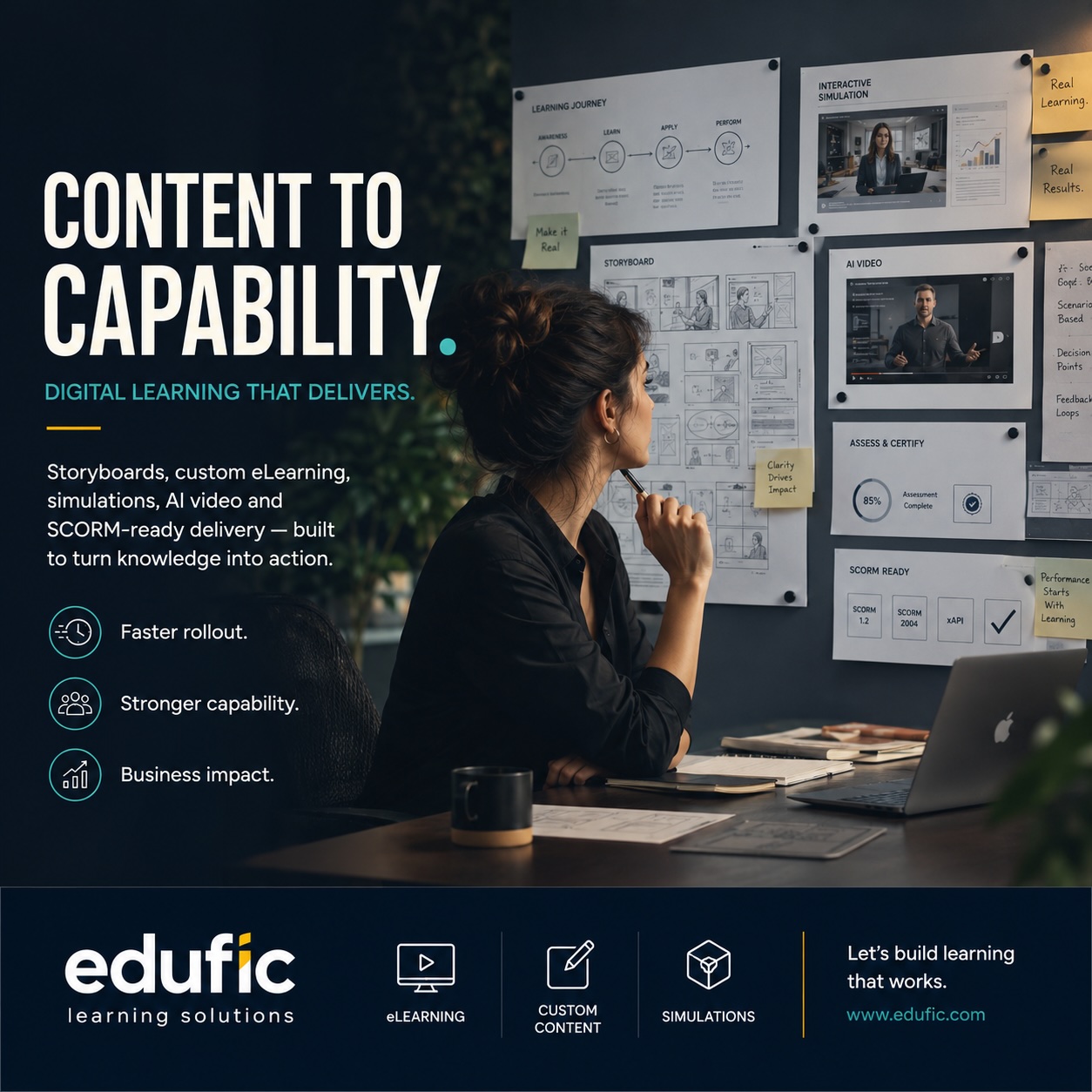
At Edufic, we help organisations transform raw training material into custom eLearning solutions, simulations, AI video learning, process training and SCORM-ready digital courses that help employees learn, apply and perform better.
Because the goal of learning is not just to explain what people need to know.
The goal is to help them do what they need to do.
Why Content Alone Is Not Enough
Many organisations already have a lot of training content. In fact, the problem is often not a lack of content. The problem is that the content is not structured for learning.
A 60-page policy document may contain everything employees need to know, but it may not help them make the right decision at work.
A process manual may explain every step, but it may not prepare employees to handle exceptions.
A PowerPoint deck may cover the subject in detail, but it may not engage learners or help them apply the knowledge.
A subject matter expert may provide accurate information, but the learner still needs guidance, structure and context.
This is where content needs to be redesigned as a learning experience.
The learner does not simply need more information.
The learner needs clarity, relevance, practice and confidence.
What Does “Content to Capability” Mean?
Content to capability means transforming information into practical learning that supports workplace performance.
It is the shift from “Here is what you need to know” to “Here is how you use it.”
This transformation involves more than converting documents into screens. It requires instructional design, learner analysis, content structuring, visual design, interactivity, scenarios, assessments and performance support.
For example:
A policy document can become scenario-based compliance training.
A process manual can become an interactive process simulation.
A product deck can become sales enablement microlearning.
A system guide can become software simulation training.
An SME interview can become an AI video learning module.
A long training manual can become a structured onboarding journey.
This is how content becomes capability.
The Role of Instructional Design
Instructional design is the bridge between content and learning impact.
Good instructional design helps decide what should be taught, what should be simplified, what should be practised, what should be reinforced and what should be measured.
It answers important questions:
Who is the learner?
What do they need to do differently?
What business outcome should the learning support?
What content is essential?
What content can become reference material?
Where will learners need examples?
Where will they need practice?
What mistakes should the training help prevent?
How should learning success be measured?
Without instructional design, digital learning can become a content dump.
With instructional design, the same content can become a clear, structured and useful learning journey.
Custom eLearning That Builds Capability
Custom eLearning allows organisations to design learning around their specific business needs, learner roles and workplace realities.
Unlike generic training, custom eLearning reflects the organisation’s language, processes, culture, systems, risks and performance expectations.
This makes the learning more relevant and easier to apply.
A custom eLearning solution can support:
Employee onboarding
Compliance training
Process training
Software and system training
Sales training
Customer service training
Leadership development
Product training
Safety training
Workplace behaviour training
Digital transformation programmes
The strength of custom eLearning is that it can be built around what people actually need to do at work.
This is what turns learning into capability.
Scenario-Based Learning for Better Decision-Making
Many workplace challenges are not about remembering information. They are about making the right decision at the right time.
This is especially true in areas such as compliance, ethics, customer service, sales, leadership, safety and people management.
Scenario-based learning helps learners practise decision-making in a safe environment.
Instead of simply reading a rule, learners are placed in a realistic situation. They are asked to choose what they would do. They see the consequence of that choice. They receive feedback and learn how to respond better.
This makes learning more practical and memorable.
A scenario can turn a policy into a decision.
A decision can turn knowledge into judgement.
And judgement is a key part of capability.
Simulation Training for Real-World Practice
For process and system training, simulations are one of the most powerful ways to build capability.
A system demo shows employees what to do.
A simulation allows them to practise doing it.
Simulation-based learning is useful for ERP training, CRM training, HRMS training, LMS training, banking systems, retail platforms, internal tools and operational workflows.
It allows learners to practise steps, make decisions, receive feedback and build confidence before working in the live environment.
This helps reduce errors, improve adoption and support better workplace performance.
When learners practise in a safe digital environment, they are better prepared to perform in the real one.
AI Video Learning with Human Learning Design
AI is helping organisations create learning content faster than before.
AI-assisted video, avatar-led learning, voice generation and visual production can help reduce production timelines and support scale.
But speed alone is not the goal.
The real goal is effective learning.
AI video learning still needs strong scripting, instructional design, visual direction, content accuracy and quality assurance. Without human learning design, AI-generated content may look polished but fail to create real understanding or application.
At Edufic, we use AI as an accelerator while keeping learning design at the centre.
This helps organisations create video-led learning that is fast, clear, engaging and aligned to performance outcomes.
AI can help speed up production.
Human design ensures the learning works.
SCORM-Ready Courses for Enterprise Delivery
For many organisations, digital learning must also be easy to launch, track and manage.
SCORM-ready courses allow organisations to deploy learning through a Learning Management System and track completion, scores and learner progress.
This is important for enterprise learning programmes, compliance training, onboarding journeys, process training and large-scale rollouts.
A SCORM-ready course helps organisations maintain consistency, reporting and accountability across teams and locations.
At Edufic, we create LMS-ready and SCORM-compliant eLearning that supports enterprise delivery needs while still focusing on learner experience and business impact.
From Documents to Digital Learning Experiences
Many learning projects begin with raw content.
This could include policy documents, training decks, product manuals, process notes, SME recordings, SOPs, system screenshots or reference guides.
The challenge is to convert this material into a format that learners can understand and use.
This may involve:
Cleaning and structuring the content
Identifying key learning outcomes
Removing unnecessary detail
Creating a learner-friendly flow
Writing clear storyboard content
Designing visuals and interactions
Adding scenarios and examples
Building assessments
Creating videos or simulations
Packaging the course for LMS delivery
This is not just production.
It is learning transformation.
The output is not simply a digital version of the original content.
The output is a learning experience that helps employees build capability.
Why Capability Matters More Than Completion
Many organisations still measure learning primarily through completion rates.
Completion is useful, but it is not enough.
A learner can complete a course without being ready to apply the learning.
The real question is: what changed after the course?
Did employees perform better?
Did they make fewer mistakes?
Did they apply the process correctly?
Did they understand compliance expectations?
Did system adoption improve?
Did onboarding become faster?
Did confidence increase?
Did the business see measurable impact?
Capability is about application.
It is about what people can do after the learning, not just whether they finished it.
That is why learning should be designed with performance in mind from the beginning.
Building Capability Across the Employee Journey
The content-to-capability approach can support employees across multiple stages of their journey.
For new hires, it can build onboarding confidence.
For existing employees, it can support upskilling and reskilling.
For managers, it can improve leadership and people decisions.
For frontline teams, it can provide quick, practical support.
For compliance learners, it can strengthen ethical and risk-aware behaviour.
For system users, it can improve process and platform adoption.
For sales and service teams, it can improve customer conversations and performance.
Different groups may need different learning formats, but the goal remains the same: help people perform better.
How Edufic Helps Organisations Move from Content to Capability
At Edufic, we design custom digital learning solutions that help organisations transform knowledge into action.
Our services include:
Custom eLearning development
Instructional design
Storyboard development
Scenario-based learning
Simulation training
AI video learning
Process training
Onboarding learning
Compliance training
Mobile learning
Microlearning
SCORM-ready course development
Learning videos
Digital learning production
We work with organisations to understand their goals, learners, workflows and content. Then we design learning solutions that are practical, engaging, scalable and outcome-focused.
The aim is not to create more content.
The aim is to create better capability.
The Future of Corporate Learning Is Performance-Led
The future of corporate learning is not about longer courses or more information.
It is about practical learning that supports real work.
Organisations need learning that is clear, relevant, accessible and measurable. They need learning that helps people adopt processes, understand systems, make better decisions and perform with confidence.
This requires moving beyond content delivery.
It requires moving toward capability building.
Content tells people what to know.
Capability helps people act.
From Content to Capability
Content is only the starting point.
When content is designed well, it becomes learning.
When learning is applied well, it becomes capability.
And when capability improves performance, learning creates business impact.
At Edufic, we help organisations turn raw training material, SME inputs, policies, process documents and knowledge resources into custom eLearning, simulations, AI video learning and SCORM-ready courses that people can understand, apply and use at work.
Faster rollout.
Stronger capability.
Measurable business impact.
Let’s build learning that works.
#Edufic #Elearning #CustomElearning #DigitalLearning #CorporateLearning #InstructionalDesign #LearningDesign #LearningExperienceDesign #CorporateTraining #EmployeeTraining #WorkplaceLearning #ProcessTraining #SimulationTraining #AIVideoLearning #SCORM #ContentToCapability #PerformanceSupport #LearningAndDevelopment
Meta Title: From Content to Capability: How Custom eLearning Drives Business Impact | Edufic Digital
Meta Description: Learn how Edufic transforms raw content, SME inputs, policies and process documents into custom eLearning, simulations, AI video learning and SCORM-ready courses that build real workplace capability.
Suggested URL Slug: content-to-capability-custom-elearning