
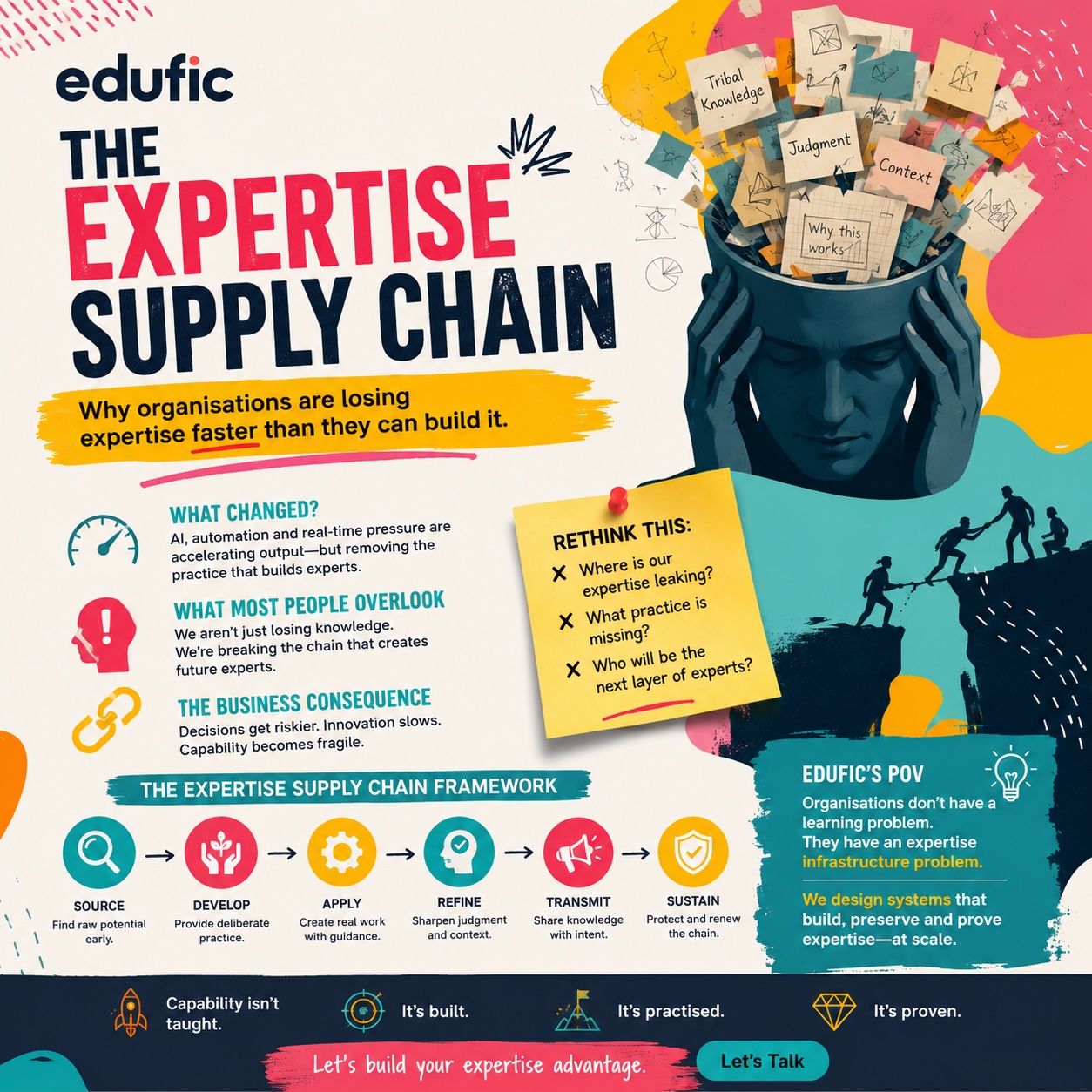
The Expertise Supply Chain: Why Organisations Are Losing Expertise Faster Than They Can Build It

The Expertise Supply Chain: Why Organisations Are Losing Expertise Faster Than They Can Build It
Organisations are moving faster than ever.
AI, automation, digital tools, real-time dashboards, faster customer expectations and changing business models are reshaping the way work gets done.
But while work is becoming faster, one critical question is becoming harder to answer.
How do organisations build experts fast enough?
Most businesses already have knowledge. They have SOPs, process documents, policies, training decks, product guides, system manuals, FAQs, recordings and internal experts.
But knowledge is not the same as expertise.
Knowledge can be stored.
Expertise must be built.
This is why many organisations are not facing only a learning problem. They are facing an expertise supply chain problem.
What Is the Expertise Supply Chain?
The expertise supply chain is the system through which organisations identify, develop, apply, refine, transfer and sustain expertise.
It is how potential becomes capability.
It is how capability becomes judgement.
It is how judgement becomes performance.
It is how expert knowledge is passed from one layer of the workforce to the next.
A strong expertise supply chain does not depend only on courses. It includes deliberate practice, real work application, feedback, coaching, knowledge transfer, simulations, performance support and evidence of capability.
At Edufic Digital, we believe this is one of the most important learning and development challenges for modern organisations.
If expertise is not intentionally built, it starts to leak.
Why Expertise Is Becoming Fragile
In many organisations, expertise still lives inside a small group of experienced people.
They know the exceptions.
They understand the judgement calls.
They know why a process works.
They know when not to follow the process blindly.
They know the hidden risks.
They know what good looks like.
But these experts are often busy, ageing, moving roles, leaving organisations, or being stretched across too many business needs.
At the same time, new employees are expected to become productive faster. Teams are expected to adapt quickly. Processes change often. Technology keeps evolving.
This creates a capability gap.
The organisation may have content, but not enough practice.
It may have training, but not enough judgement.
It may have knowledge repositories, but not enough transfer.
It may have completed courses, but not enough proven capability.
The Business Consequence of Weak Expertise Transfer
When expertise does not transfer well, the cost shows up in the business.
Decisions become riskier.
Innovation slows down.
Process quality becomes inconsistent.
Managers spend more time correcting mistakes.
New employees take longer to become productive.
Customer experience becomes uneven.
Compliance risk increases.
Critical knowledge becomes dependent on a few people.
Capability becomes fragile.
This is not just an L&D issue.
It is a business continuity issue.
An organisation that cannot build its next layer of experts becomes dependent on its current layer for too long.
That slows growth.
Why Content Alone Cannot Build Experts
Many organisations respond to capability gaps by creating more content.
More courses.
More decks.
More videos.
More manuals.
More knowledge articles.
More onboarding material.
More refreshers.
Content is important, but content alone does not build expertise.
Expertise is built through application.
A person becomes expert by using knowledge in context, making decisions, receiving feedback, seeing consequences, correcting mistakes and developing judgement over time.
A compliance document can explain the policy.
But it does not automatically build ethical judgement.
A process manual can list the steps.
But it does not automatically build the ability to handle exceptions.
A product guide can explain features.
But it does not automatically build customer-facing confidence.
A leadership model can explain behaviours.
But it does not automatically build coaching skill.
To build expertise, organisations need more than information.
They need practice systems.
The Role of Deliberate Practice
Deliberate practice is structured practice designed to improve performance.
It is not random repetition.
It is focused, guided and feedback-driven.
In workplace learning, deliberate practice may include:
Scenario-based learning
Simulation training
Role-based exercises
Guided decision practice
Manager coaching
Reflection activities
Feedback loops
Performance support
Practice assignments
Peer review
Real-world application tasks
This kind of practice helps learners move from awareness to capability.
It gives employees the chance to try, fail safely, improve and build confidence before the stakes are high.
That is how expertise begins to form.
Source: Finding Raw Potential Early
The first stage of the expertise supply chain is sourcing potential.
Organisations need to identify where future capability can come from.
This may include new hires, frontline employees, high-potential talent, managers, technical specialists, sales teams, operations teams or experienced employees who can become trainers, coaches or mentors.
Sourcing expertise is not only about identifying top performers.
It is about understanding who can learn, apply, adapt and transfer knowledge effectively.
L&D and HR teams can support this by mapping critical roles, identifying capability gaps and designing learning pathways for future experts.
Develop: Building Through Practice
The second stage is development.
This is where training must move beyond content delivery.
Employees need structured learning journeys that build understanding, application and judgement.
Development may include custom eLearning, simulations, microlearning, scenario-based practice, live workshops, AI video learning, role-based modules and manager-led reinforcement.
The goal is not simply to expose people to knowledge.
The goal is to help them use it.
A good development pathway should answer:
What does the learner need to know?
What do they need to practise?
Where will they make mistakes?
What feedback will improve judgement?
How will they apply this in real work?
How will progress be measured?
This is how capability begins to become visible.
Apply: Creating Real Work With Guidance
Expertise cannot develop fully inside a course.
It needs real work.
The apply stage is where learners use knowledge in workplace situations with the right level of guidance.
This may include project assignments, coached tasks, system practice, customer scenarios, job shadowing, workflow practice or performance support.
The purpose is to reduce the gap between learning and doing.
When employees apply learning in context, they begin to understand nuance.
They see what changes when the situation is real.
They learn what the course could not fully explain.
This is where expertise deepens.
Refine: Sharpening Judgement and Context
The refine stage is where feedback becomes essential.
People do not become experts just by doing work.
They become experts by reflecting on what happened, understanding what worked, correcting what did not and building better judgement for next time.
Refinement can happen through manager coaching, peer review, feedback sessions, performance analytics, simulation debriefs, scenario discussions or post-action reviews.
This stage helps learners understand:
Why did this decision work?
What could have gone wrong?
What should be done differently next time?
What pattern should be recognised earlier?
What risk was missed?
What judgement improved?
Refinement is where experience turns into expertise.
Transmit: Sharing Knowledge With Intent
A weak expertise supply chain breaks when knowledge stays inside a few people.
The transmit stage focuses on making expertise transferable.
This does not mean simply asking experts to create a deck or record a video.
It means capturing how experts think, decide and solve problems.
Expertise transmission may include:
Expert interviews
Scenario libraries
Decision maps
Coaching guides
Knowledge transfer sessions
Mentor pathways
Case studies
Role-play scenarios
Process walkthroughs
Lessons learned repositories
Communities of practice
The aim is to help others understand not only what experts know, but how experts think.
This is one of the most valuable roles L&D can play in modern organisations.
Sustain: Protecting and Renewing the Chain
The final stage is sustain.
Expertise must be refreshed, updated and renewed as business conditions change.
Processes evolve.
Tools change.
Customer expectations shift.
Regulations are updated.
Markets move.
AI changes workflows.
New risks emerge.
A learning system must continuously update capability, not just deliver one-time training.
Sustaining expertise may require refresher learning, updated simulations, performance support, learning analytics, capability assessments and ongoing reinforcement.
The goal is to ensure expertise does not become outdated or concentrated in too few people.
Why AI Makes the Expertise Supply Chain More Important
AI can help organisations create content faster, automate tasks and improve access to information.
But AI does not remove the need for human expertise.
In many cases, it increases the need for judgement.
Employees need to know how to interpret AI output, validate decisions, manage exceptions, handle ethical questions and apply context.
AI may accelerate work, but people still need capability.
That means organisations must invest in learning systems that build judgement, not just knowledge access.
The future of learning is not only about AI-generated content.
It is about AI-era expertise.
How Edufic Digital Helps Build Expertise at Scale
At Edufic Digital, we help organisations design digital learning systems that build, preserve and prove expertise.
Our work supports:
Custom eLearning
Scenario-based learning
Simulation training
AI video learning
Capability development
Leadership development
Compliance training
Onboarding training
Process learning
Product training
Sales enablement
Performance support
Microlearning
Learning analytics
Knowledge transfer
SCORM-ready course development
We help organisations move from content delivery to capability building.
Our approach focuses on clarity, practice, application, feedback and measurable outcomes.
The goal is to help people become more capable, not just more informed.
Questions Every L&D Leader Should Ask
To strengthen the expertise supply chain, L&D and business leaders should ask:
Where is expertise concentrated today?
Where is expertise leaking?
Which roles are hardest to replace?
Which decisions depend on experience?
What practice is missing?
How are experts transferring judgement?
Who will become the next layer of experts?
How is capability being proven?
What happens when experienced people leave?
How can learning support faster expertise development?
These questions move learning from a support function to a strategic capability function.
The Future of L&D Is Expertise Infrastructure
The next phase of learning and development will not be defined only by course libraries, LMS completion or content production.
It will be defined by how well organisations build expertise.
L&D teams will be expected to support workforce transformation, capability development, knowledge transfer, AI adoption, leadership readiness and business performance.
That requires expertise infrastructure.
Not just training.
Not just content.
Not just completion.
A system that builds, applies, refines, transmits and sustains capability.
The Expertise Supply Chain
Organisations do not just have a learning problem.
They have an expertise infrastructure problem.
Expertise is not created by content alone. It is built through deliberate practice, real work application, guided feedback, context, judgement and knowledge transfer.
At Edufic Digital, we design learning systems that build, preserve and prove expertise at scale.
Capability is not taught.
It is built.
It is practised.
It is proven.
Let’s build your expertise advantage.
#Edufic #EduficDigital #LearningAndDevelopment #CorporateLearning #ExpertiseDevelopment #CapabilityBuilding #WorkplaceLearning #DigitalLearning #CustomElearning #LearningStrategy #InstructionalDesign #TalentDevelopment #KnowledgeTransfer #OrganisationalCapability #SkillsDevelopment #PerformanceImprovement #LearningExperienceDesign #LXD #WorkforceTransformation #FutureOfWork #AIInLearning #CorporateTraining #EmployeeTraining #LeadershipDevelopment #BusinessImpact
Meta Title: The Expertise Supply Chain: Why Organisations Are Losing Expertise Faster Than They Can Build It
Meta Description: Learn why organisations need to build an expertise supply chain through deliberate practice, knowledge transfer, workplace learning and capability development in the age of AI and automation.
Suggested URL Slug: expertise-supply-chain-capability-building