
Workplace Learning Should Build Readiness, Not Just Knowledge
Training often focuses on what people need to know.
But performance depends on what people can do when the situation becomes difficult, unfamiliar or time-sensitive.
That is the real test of workplace learning.
An employee may know the policy, but still hesitate when faced with a real compliance decision. A manager may understand the leadership model, but still struggle during a difficult conversation. A customer service executive may remember the process, but feel unsure when a customer is upset. A technician may know the steps, but still need confidence when the situation becomes urgent.
In these moments, knowledge alone is not enough.
People need judgement.
They need practice.
They need feedback.
They need readiness.
That is why effective workplace learning must do more than deliver information. It must prepare employees to act with confidence when the real situation arrives.
Why Knowing Is Not the Same as Being Ready
Most corporate training programmes begin with content.
There are policies to explain, processes to introduce, systems to demonstrate, products to describe and behaviours to encourage.
This content matters. Employees need the right information to do their jobs well.
But information is only the starting point.
The workplace does not simply ask people to recall what they learned. It asks them to apply it in real situations, often with pressure, ambiguity and consequences.
That is where many learning programmes fall short.
A learner may complete the course and pass the assessment, but still not feel ready to use the learning at work.
This is the gap between knowledge and readiness.
Readiness is the ability to apply knowledge, make decisions, respond appropriately and perform with confidence in real workplace contexts.
The Role of Judgement in Workplace Performance
Judgement is one of the most important outcomes of effective learning.
Many workplace situations do not have a simple, obvious answer. Employees need to interpret context, understand risk, balance priorities and choose the right action.
This is especially true in areas such as:
Compliance training
Customer service training
Leadership development
Safety training
Sales training
Process training
Onboarding
Behavioural training
System and workflow training
In each of these areas, employees are not just expected to remember information. They are expected to make decisions.
Good workplace learning helps people practise judgement before the stakes are real.
Why Scenarios Make Learning More Practical
Realistic scenarios are one of the most effective ways to build workplace readiness.
A scenario places the learner inside a real or realistic situation and asks them to respond.
Instead of asking, “Do you remember the rule?” it asks, “What would you do here?”
That shift matters.
Scenarios help employees:
Navigate ambiguity
Make decisions under pressure
Understand the consequences of their choices
Recognise common workplace challenges
Practise real responses in a safe environment
Build confidence before the real moment arrives
Scenario-based learning is powerful because it reflects the way work actually happens.
Work is not a list of definitions. Work is a series of situations, choices and outcomes.
The more learning mirrors that reality, the more useful it becomes.
Simulation-Based Learning Builds Confidence
Simulations take practice even further.
A simulation allows employees to try a process, system, decision or workflow in a safe digital environment.
This is especially useful when mistakes in real life can be costly, risky or difficult to correct.
Simulation-based learning can support:
Software training
System adoption
Process learning
Operational workflows
Customer service situations
Safety procedures
Compliance decisions
Role-based practice
A demo shows employees what to do.
A simulation lets them do it.
That difference is important.
When learners practise through simulations, they build confidence. They become familiar with the steps, the decisions and the possible consequences. They make mistakes safely and improve before working in the real environment.
This helps reduce hesitation and improves workplace application.
Why Feedback Is Critical to Learning
Practice without feedback is incomplete.
When employees make a decision during training, they need to understand why that choice was strong, weak or risky.
Good feedback helps learners improve their thinking.
It explains:
What worked
What could have gone wrong
What risk was avoided
What consequence followed
What better action could be taken
How the learning applies to real work
Feedback should feel like coaching.
It should not only tell learners whether they were right or wrong. It should help them understand the reasoning behind the decision.
This is how learning becomes deeper.
This is how knowledge becomes judgement.
This is how judgement becomes readiness.
Moving Beyond Course Completion
Course completion is easy to measure.
Readiness is more valuable.
A completion report can show that employees finished a course, but it cannot always prove that they are prepared to perform.
The real value of training is not measured by whether someone reached the final screen.
It is measured by whether they can apply the learning when it matters.
Organisations should ask:
Can employees make better decisions?
Can they follow the process correctly?
Can they respond to difficult situations?
Can they apply the policy in context?
Can they use the system confidently?
Can they reduce errors?
Can they act without unnecessary hesitation?
Can managers see improved performance?
These are readiness questions.
And they are more closely connected to business outcomes.
Learning That Connects Directly to Workplace Performance
Effective workplace learning should be designed around performance from the beginning.
That means the learning design process should start with the question:
What should people be able to do after this training?
From there, the learning experience can be built around the skills, situations, decisions and behaviours that matter most.
This may include:
Custom eLearning
Scenario-based learning
Simulation-based learning
Microlearning
Performance support
Role-based learning paths
Knowledge checks with feedback
Digital practice environments
Manager reinforcement tools
Job aids and quick reference guides
The right solution depends on the business need.
But the goal should always be the same: help people perform better in real work situations.
Examples of Readiness-Focused Learning
In compliance training, readiness means employees can recognise risk and make the right decision before a mistake happens.
In onboarding, readiness means new hires know how to begin contributing with confidence.
In leadership development, readiness means managers can coach, give feedback and handle difficult conversations with care.
In customer service training, readiness means employees can respond clearly, calmly and effectively when customers need help.
In safety training, readiness means workers can identify hazards and act before risk becomes an incident.
In sales training, readiness means teams can understand customer needs, handle objections and communicate value.
In process training, readiness means employees can follow workflows accurately and handle exceptions.
Each of these outcomes requires more than knowledge.
They require practice and application.
Why Custom Digital Learning Matters
Generic learning may introduce a topic, but custom digital learning can make it relevant to the organisation’s real work.
Custom learning can reflect the organisation’s processes, roles, language, systems, risks, customers, workplace culture and performance expectations.
This makes learning more practical and easier to apply.
At Edufic, we design custom digital learning experiences that connect learning directly to workplace performance.
We help organisations move from content delivery to capability building.
Our solutions can include custom eLearning, scenario-based learning, simulation-based learning, process training, compliance learning, onboarding programmes, leadership development, employee training and performance support.
The focus is not just to create a course.
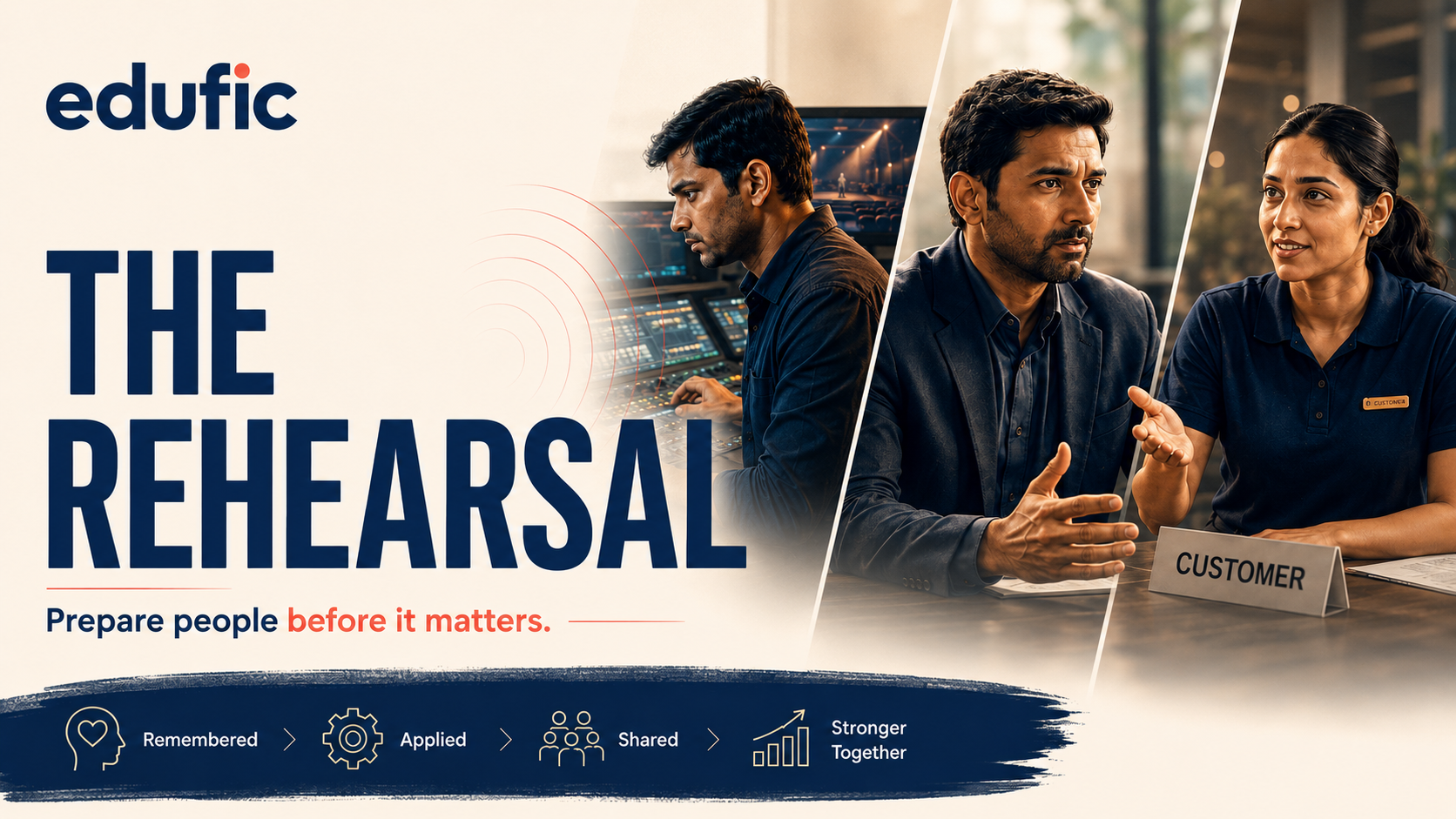
The focus is to prepare people before it matters.
Building Confidence Before the Real Situation Arrives
Confidence is a major part of readiness.
Employees are more likely to act well when they have already practised similar situations.
Confidence grows when learners understand what to do, why it matters and how to respond when the situation is not perfect.
This is why scenarios, simulations and feedback are so important.
They allow learners to experience the challenge before it becomes real.
They help people prepare for pressure, ambiguity and consequence.
They make learning feel closer to work.
And when learning feels closer to work, employees are more likely to use it.
Prepare People Before It Matters
Training often focuses on what people need to know.
But performance depends on what people can do when the situation becomes difficult, unfamiliar or time-sensitive.
That is why effective workplace learning should create opportunities to practise judgement, not just recall information.
Realistic scenarios and simulations help employees navigate ambiguity, make decisions under pressure, understand consequences, improve through feedback and build confidence before the real situation arrives.
At Edufic, we design custom digital learning experiences that connect learning directly to workplace performance.
Because the value of training is not measured by completion.
It is measured by readiness.
Edufic. Prepare people before it matters.
Explore more at edufic.com
#Edufic #CorporateLearning #CustomELearning #DigitalLearning #WorkplaceLearning #ScenarioBasedLearning #SimulationBasedLearning #LearningAndDevelopment #CapabilityBuilding #EmployeeTraining #InstructionalDesign #PerformanceImprovement
Meta Title: Why Workplace Learning Must Build Readiness, Not Just Knowledge
Meta Description: Learn why effective workplace learning should go beyond knowledge recall and use realistic scenarios, simulations and feedback to build employee readiness, judgement and performance.
Suggested URL Slug: workplace-learning-readiness-scenarios-simulations