
The Course Isn’t Long. It’s Lost.
When learners drop off midway through an eLearning course, the first reaction is often simple.
“The course is too long.”
So teams try to cut the duration. They reduce slides. They shorten the voice-over. They remove a few examples. They compress the content.
Sometimes that helps.
But often, length is not the real problem.
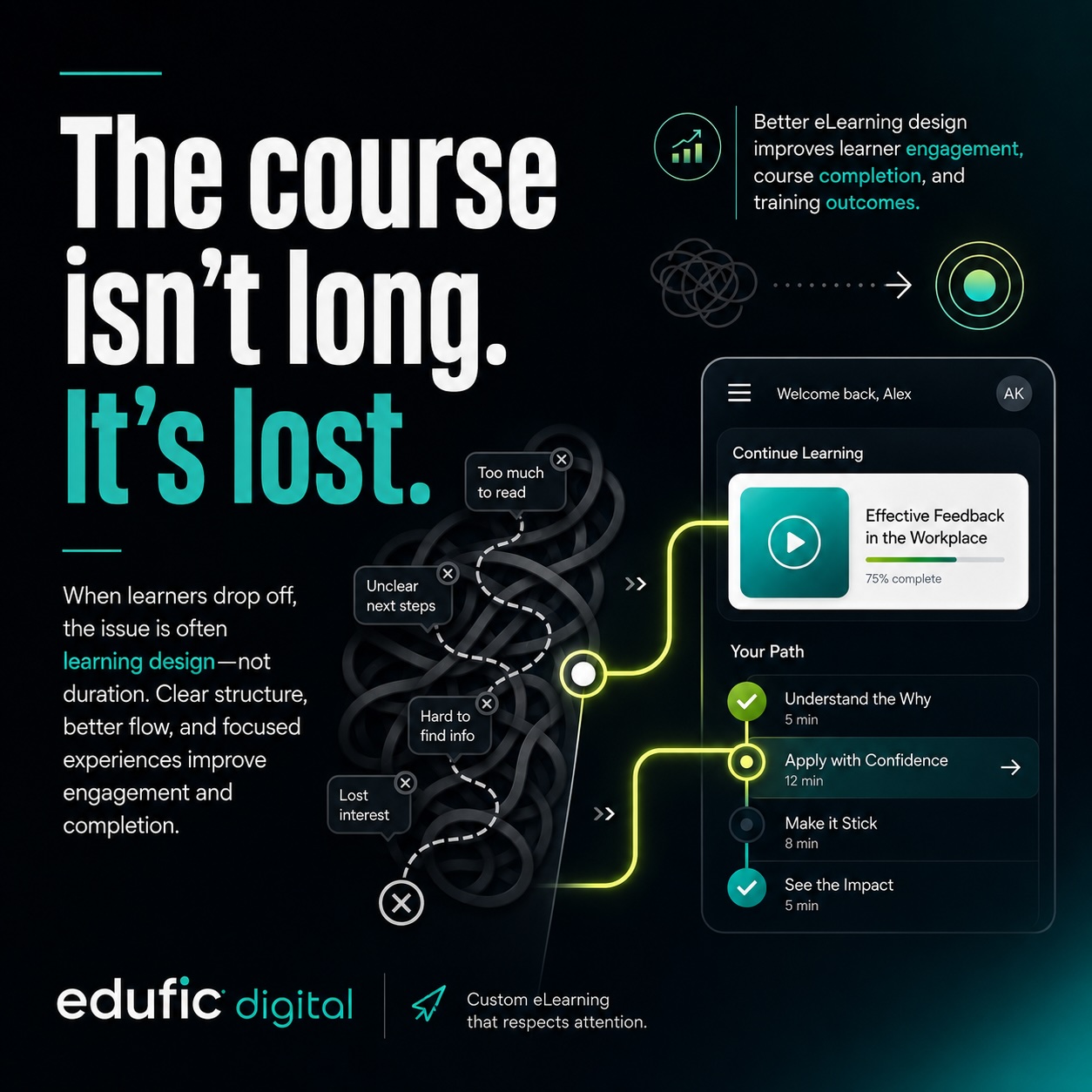
The real problem is that the course feels lost.
Learners are not always tired because a course is long. They are tired because the course makes them work too hard to understand where they are, what matters, why they are learning it, and what they are supposed to do next.
That is where learning design makes the difference.
A well-designed eLearning course does more than present content. It creates direction, flow, clarity and purpose. It helps learners move from information to action.
Because better structure improves attention. Better flow improves completion. Better design improves learning outcomes.
Why Learners Drop Off During eLearning Courses
Learner drop-off is one of the most common challenges in corporate eLearning.
A learner begins the course with good intent. They know the training is important. They may even understand that it is mandatory. But somewhere along the way, attention fades.
The learner starts clicking faster. They stop listening closely. They scan instead of absorb. They complete the course, but the learning does not fully land.
This does not always happen because the content is irrelevant.
It often happens because the learning experience is not designed well enough.
The learner may be asking:
Where am I in this course?
Why am I learning this now?
What is important here?
How does this connect to my role?
What should I do with this information?
How much more is left?
What is the key takeaway?
When these questions are not answered clearly, the course starts to feel heavy.
Not because it is long.
Because it is unclear.
The Difference Between Content and Learning
Many corporate training programmes begin with large amounts of content.
There may be policy documents, process notes, PowerPoint decks, SME inputs, system screenshots, compliance guidelines, product information and reference material.
All of this may be accurate.
But accuracy alone does not create learning.
A content-heavy course can still fail if it does not help learners understand, apply and remember what matters.
Content tells people what exists.
Learning helps people know what to do.
That is why custom eLearning design is not simply about converting content into screens. It is about transforming content into a structured learning experience.
A good instructional design process identifies what is essential, what can be simplified, what needs context, what should become a scenario, and what should be available as reference material.
Without that design thinking, a course can become a content dump.
And content dumps are tiring even when they are short.
Why Course Length Is Not Always the Problem
Course duration matters, but it is not the only factor that affects learner engagement.
A 15-minute course can feel exhausting if it is confusing, repetitive or poorly structured.
A 45-minute course can feel useful if it has a clear journey, strong examples, meaningful practice and a logical flow.
Learners are more willing to stay with a course when they understand why it matters and where it is going.
Length becomes a problem when the course has no rhythm.
For example, a course may feel long when:
Every screen looks equally important.
Too much information is presented at once.
The learner does not know what to focus on.
The course repeats the same point in different words.
Activities feel disconnected from the content.
The navigation feels unclear.
The examples do not connect to real work.
The assessment appears suddenly at the end.
There is no visible sense of progress.
In these cases, reducing duration may not solve the issue.
The course needs better learning design.
Learning Design Creates Direction
Every effective eLearning course needs a sense of direction.
The learner should know where the course begins, where it is going and why each step matters.
This does not mean over-explaining everything. It means creating a clear path.
A strong learning journey usually answers three questions:
What do I need to know?
Why does it matter?
How will I use it?
When these questions are answered at the right time, learners feel guided instead of lost.
Direction is especially important in corporate learning, where employees are often learning alongside their daily work pressures. They do not have the patience for unnecessary friction.
Good learning design respects learner attention.
It helps learners focus on what matters most.
Flow Keeps Learners Moving
Flow is one of the most underrated parts of instructional design.
A course can have good visuals, voice-over and interactivity, but if the flow is weak, the learner will still struggle.
Strong flow means the content is sequenced in a way that feels natural.
The course introduces concepts before asking learners to apply them. It gives context before details. It uses examples before assessment. It places practice moments where they help reinforce understanding.
Good flow helps learners move from one idea to the next without feeling like they are jumping between disconnected screens.
Without flow, learners feel like they are walking through a maze.
With flow, learners feel like they are moving through a journey.
Clarity Reduces Cognitive Load
Corporate learners are busy people.
They are managing deadlines, meetings, customers, processes, systems, targets and decisions. When they enter a training module, they do not need more complexity.
They need clarity.
Clarity in eLearning comes from:
Focused messaging
Clean visual hierarchy
Simple navigation
Clear instructions
Strong screen structure
Relevant examples
Purposeful interactions
Consistent design patterns
Useful summaries
Meaningful feedback
Clarity also comes from knowing what to leave out.
Not every detail belongs in the main learning journey. Some information may be better placed in a downloadable job aid, reference guide or performance support tool.
Good learning design does not reduce value.
It reduces friction.
Purpose Makes Learning Meaningful
Learners engage more when they understand the purpose behind the content.
A compliance rule becomes meaningful when it is connected to a real workplace decision.
A process becomes easier to remember when it is shown in context.
A system step becomes clearer when the learner understands the task behind the click.
A policy becomes more memorable when it is linked to people, risk, safety, service or performance.
Purpose gives learning relevance.
Without purpose, training feels like instruction.
With purpose, training feels like preparation.
This is especially important for corporate training topics such as compliance training, onboarding, process training, leadership development, customer service training and sales enablement.
Learners do not just need to know the content.
They need to know why it matters at work.
From Information to Action
The goal of eLearning is not simply to transfer information.
The goal is to help learners act differently, decide better, apply knowledge and perform with confidence.
This is where learning experience design becomes important.
A well-designed digital learning course helps learners move through stages:
Awareness
Understanding
Practice
Application
Reflection
Reinforcement
This may include scenario-based learning, simulations, microlearning, knowledge checks, decision points, feedback loops, job aids and performance support.
The right format depends on the learning objective.
But the goal stays the same: help people use what they learn.
Better Structure Improves Attention
Learner attention improves when the course is structured well.
Structure helps learners understand what is coming next, what they should focus on and how each section connects to the larger outcome.
A structured eLearning course may include:
A clear opening hook
A simple learning promise
Short sections
Logical sequencing
Visible progress
Relevant examples
Practice opportunities
Recap moments
Clear takeaways
Action-oriented closing
This kind of structure makes the course easier to follow.
Learners do not have to spend energy figuring out the course.
They can spend their energy learning.
Better Flow Improves Completion
Completion improves when learners feel that the course is moving with purpose.
A learner is more likely to complete a course when each screen feels necessary, each activity has a reason and each section adds value.
Good flow also reduces frustration.
Learners are less likely to drop off when they feel guided, supported and oriented.
This is why learner engagement is not only about adding more interactions or better visuals. Engagement also comes from removing confusion.
A clear course feels shorter.
A confused course feels longer.
Better Design Improves Learning Outcomes
Learning outcomes improve when the experience is designed around application.
A well-designed eLearning course does not ask learners to remember everything. It helps them understand what matters, practise what matters and apply what matters.
This is where instructional design, visual design and learning technology come together.
The course should be:
Easy to navigate
Relevant to the learner’s role
Focused on real outcomes
Designed with clear hierarchy
Supported by examples
Reinforced through practice
Connected to workplace performance
When design supports learning, learners are more likely to remember and use the content.
That is the real measure of training effectiveness.
How Edufic Digital Designs Custom eLearning That Works
At Edufic Digital, we design custom eLearning experiences that respect learner attention and help organisations turn training content into meaningful performance change.
We do not see eLearning as a simple conversion of documents into slides.
We see it as learning design.
That means understanding the learner, the business goal, the content, the context and the performance expectation.
Our custom eLearning solutions may include:
Instructional design
Storyboard development
Custom eLearning modules
Scenario-based learning
Simulation training
Microlearning
Process training
Onboarding learning
Compliance training
AI video learning
Mobile learning
SCORM-ready course development
Performance support tools
The aim is to build learning that is clear, structured and useful.
Not just content that is complete.
What L&D Teams Should Ask Before Shortening a Course
Before shortening a course, L&D teams should ask a better question.
Not just: “Can we make this shorter?”
But:
Is the learning journey clear?
Does the learner know why this matters?
Is the content sequenced properly?
Are we showing too much at once?
Are the examples relevant?
Is the interaction meaningful?
Does the course help the learner apply the content?
Are we reducing confusion or only reducing time?
What should the learner be able to do after this course?
Sometimes the answer is to shorten the course.
But often, the answer is to redesign the learning journey.
The Course Isn’t Long. It’s Lost.
When learners say a course is too long, it may be worth looking deeper.
Maybe the course is not too long.
Maybe it is unclear.
Maybe the learner is not bored.
Maybe the learner is disoriented.
Maybe the course does not need to be shorter.
Maybe it needs to be better designed.
Because when a learning journey has direction, flow, clarity and purpose, learners are more likely to stay with it.
They know where they are.
They know why it matters.
They know what to do next.
And most importantly, they can move from information to action.
At Edufic Digital, we design custom eLearning experiences that help learners move with clarity and confidence.
Custom eLearning. Better engagement. Clearer outcomes.
#EduficDigital #eLearningDesign #CustomELearning #LearningAndDevelopment #CorporateTraining #InstructionalDesign #DigitalLearning #LearnerEngagement #TrainingOutcomes #LMS #WorkplaceLearning #LearningExperienceDesign
Meta Title: The Course Isn’t Long. It’s Lost. Why Learning Design Matters
Meta Description: Learn why learners drop off from eLearning courses and how better learning design, structure, flow and clarity improve engagement, completion and training outcomes.
Suggested URL Slug: course-isnt-long-learning-design-matters