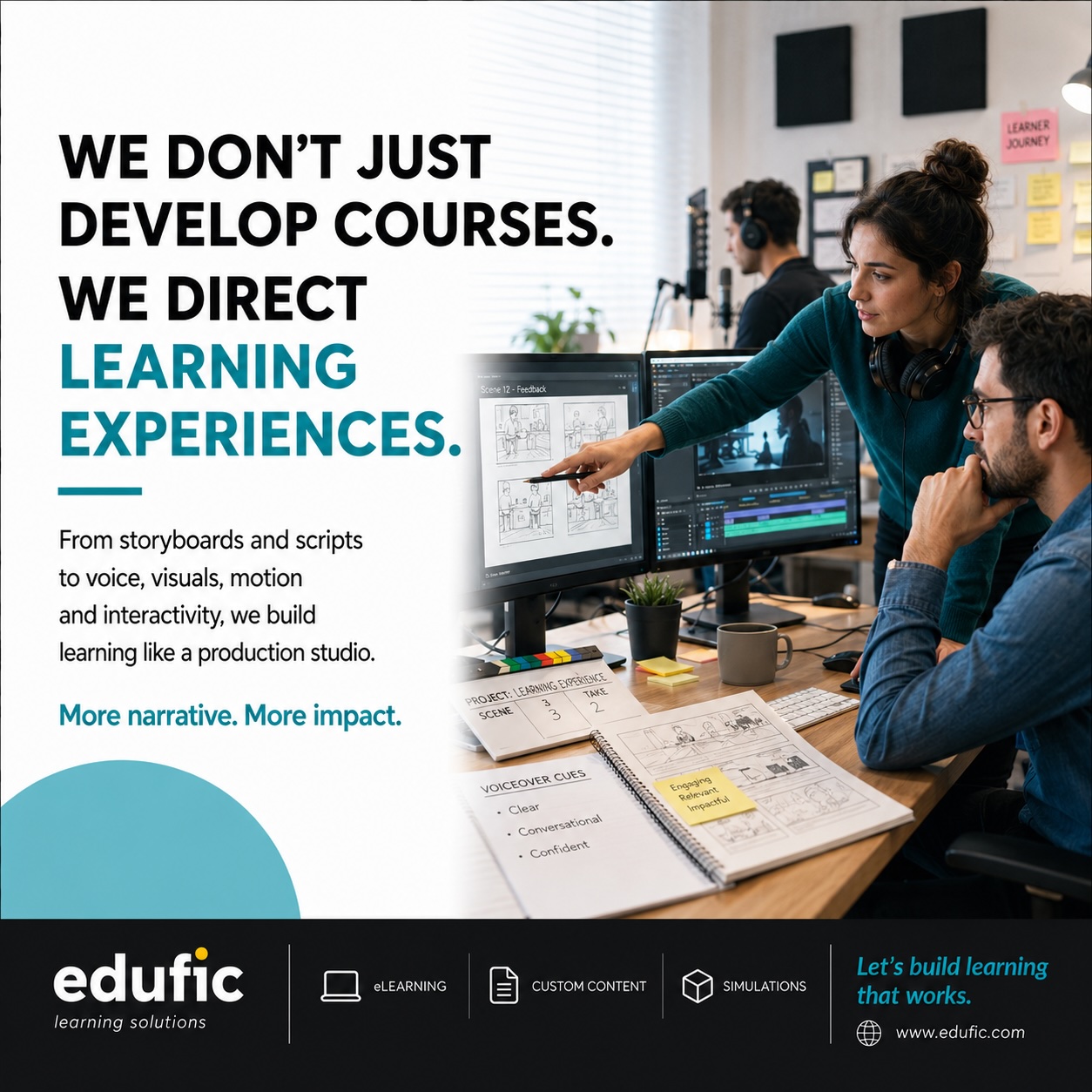

We Don’t Just Develop Courses. We Direct Learning Experiences.
A course is not just a set of screens.
It is a learning experience.
It has a beginning, a flow, a purpose, a rhythm and an outcome. It should guide the learner from curiosity to clarity, from understanding to application, and from information to performance.
That is why at Edufic, we do not look at eLearning as only course development.
We direct learning experiences.
From storyboards and scripts to voice-over, visuals, motion, interactivity and simulations, we bring together every element required to create digital learning that is engaging, practical and built for real workplace impact.
Because effective eLearning is not simply about what appears on screen.
It is about what the learner understands, remembers and applies after the screen is closed.
Why Course Development Alone Is Not Enough
Many corporate learning projects begin with a simple request: “Can you build this as an eLearning course?”
The source content may be a PowerPoint deck, a policy document, a process note, a system guide, a training manual or SME inputs. The expectation is often to convert that material into a digital module.
But conversion is not the same as learning design.
A course may be technically complete. It may have slides, interactions, narration, visuals and assessments. But if it does not create clarity or help the learner apply the knowledge, it may not create real value.
Good eLearning is not about placing content into screens.
It is about designing a journey.
The learner should know where they are, why the content matters, what they need to do with it and how it connects to their work.
That requires direction.
The Role of Narrative in Digital Learning
Every strong learning experience needs a narrative.
Narrative does not mean fiction. It means flow.
It is the logic that connects one idea to the next. It is the structure that helps learners make sense of complex information. It is the reason the learner stays engaged because the course feels purposeful, not random.
A good learning narrative answers important questions:
Why is this topic important?
What problem does it solve?
What should the learner understand first?
Where does the learner need context?
Where should the learner practise?
Where should the learner reflect?
What should the learner be able to do at the end?
When learning has narrative, it feels coherent.
When it lacks narrative, it feels like a collection of disconnected screens.
At Edufic, we use storyboards, scripts, visual flow and learning strategy to shape that narrative before development begins.
Storyboarding: Where Learning Starts Taking Shape
A storyboard is more than a document.
It is the blueprint of the learning experience.
It defines the screen flow, on-screen text, voice-over, visuals, interactions, scenarios, assessments and learner journey. It helps stakeholders see how raw content will become a structured learning experience.
Strong storyboarding helps avoid common eLearning problems such as content overload, weak flow, unclear instructions, poor engagement and late-stage rework.
A good storyboard clarifies:
What appears on screen
What the learner hears
What the learner does
What the learner sees
What the learner should think about
How the learning progresses
Where interactions add value
Where scenarios or examples are needed
How the course leads to application
This is where the course begins to move from content to experience.
Scripts and Voice-Over: Giving Learning a Human Tone
Voice-over can make digital learning feel more human, but only when it is written with care.
A good script should not simply read out the screen. It should guide the learner, explain the context, create momentum and support understanding.
The tone matters.
Compliance training may need a tone that is clear, serious and practical. Onboarding may need warmth and reassurance. Leadership learning may need reflection and confidence. Process training may need clarity and precision.
Voice-over is not just audio.
It is part of the learning direction.
At Edufic, we write scripts and voice-over content that support the learner journey instead of repeating what is already visible on screen.
Visual Design: Making Learning Easier to Understand
Visual design in eLearning is not decoration.
It is communication.
Good visual design helps learners understand faster. It creates hierarchy, reduces clutter, guides attention and makes complex content easier to follow.
A visually strong learning experience uses layout, typography, colour, iconography, imagery and motion with purpose.
It helps learners identify:
What is important
What comes next
What needs attention
What is a process
What is a decision
What is a consequence
What is a key takeaway
When visual design is used well, the learning feels lighter, clearer and more professional.
At Edufic, we design digital learning experiences that are not only attractive, but also functional and learner-friendly.
Motion Graphics and Animation: Creating Meaningful Movement
Motion graphics can bring learning to life.
But motion should never be added only for style. It should help explain, transition, compare, reveal, reinforce or simplify.
Animation is useful when it supports understanding.
For example, motion graphics can show how a process flows, how a system works, how a risk develops, how a decision leads to an outcome, or how different roles connect in a workflow.
This is especially useful in corporate training topics such as process training, compliance, onboarding, product training, safety, leadership, digital transformation and customer service.
At Edufic, we use motion and animation to improve clarity and engagement, not to distract from the learning goal.
Interactivity: Helping Learners Think and Apply
Interactivity should not be limited to clicking buttons.
The real purpose of interactivity is to make learners think.
A good interaction asks the learner to choose, explore, compare, apply, reflect or solve a problem. It should support learning, not simply create activity.
Examples of meaningful interactivity include:
Decision-based scenarios
Process walkthroughs
Click-to-explore visual maps
Branching situations
Knowledge checks
Drag-and-match activities
Reflection prompts
Software simulations
Case-based exercises
Assessment activities with feedback
When interactivity is designed well, learners do not just consume information. They participate in the learning experience.
This improves attention, recall and application.
Scenario-Based Learning: Turning Information into Judgement
Many workplace challenges are not about remembering content. They are about making the right decision at the right time.
This is why scenario-based learning is so powerful.
Scenarios place learners in realistic workplace situations. They ask learners to make choices, see consequences and receive feedback.
This is especially useful for compliance training, ethics, customer service, sales, leadership, onboarding, safety and workplace behaviour programmes.
Scenario-based learning helps learners practise judgement before they face real situations.
It turns rules into decisions.
It turns information into action.
It turns awareness into readiness.
At Edufic, we design scenarios that reflect real workplace contexts, so learners can connect the training to their day-to-day roles.
Simulation Training: Practice Before Performance
A system demo shows learners what to do.
A simulation lets them practise.
Simulation training is valuable for software training, ERP training, CRM training, HRMS training, LMS training, process training and operational workflows.
Simulations create a safe practice environment where learners can follow steps, make decisions, receive feedback and build confidence before using the real system or process.
This helps improve:
Process adoption
System confidence
Workflow accuracy
Error reduction
Operational consistency
Learner readiness
At Edufic, we build simulations that help learners move from watching to doing.
AI Video Learning with Human Direction
AI is transforming the way digital learning is produced.
AI video, avatars, synthetic voice, visual generation and automated workflows can help create learning faster and at scale.
But AI alone does not direct a learning experience.
It still needs human judgement, instructional design, scripting, review, visual direction and quality assurance.
At Edufic, we use AI as a production accelerator while keeping learning design at the centre.
This helps organisations create AI-assisted video learning that is faster to produce, but still relevant, structured and useful for learners.
AI brings speed.
Human direction brings learning impact.
SCORM-Ready Courses and Enterprise Delivery
A great learning experience also needs to be delivered properly.
For many organisations, this means SCORM-ready courses that can be uploaded to a Learning Management System and tracked for completion, progress and scores.
Edufic develops LMS-ready and SCORM-compliant digital learning that supports enterprise rollouts, compliance reporting and consistent delivery across teams and locations.
But packaging is only one part of the process.
Quality assurance, review cycles, version control, accessibility checks, functionality testing and content accuracy are all important to ensure the learning experience works as intended.
This is where production discipline matters.
The Invisible Work Behind Good eLearning
Learners only see the final course.
They do not see the analysis, scripting, storyboarding, visual direction, content structuring, design decisions, interaction planning, development logic, testing, QA and review that went into it.
But this invisible work is where quality lives.
A strong learning experience is built through careful decisions at every stage.
What should be simplified?
What should be shown visually?
Where should the learner practise?
What should be narrated?
What should be interactive?
What should be assessed?
What should be reinforced?
How should the course end?
These decisions turn content into a purposeful learning experience.
At Edufic, we bring this production mindset to every digital learning project.
Why Edufic Directs Learning Experiences
Edufic brings together the skills needed to create end-to-end digital learning experiences:
Instructional design
Storyboard development
Scriptwriting
Voice-over direction
Visual design
Motion graphics
Animation
Scenario-based learning
Simulation development
AI video learning
eLearning development
SCORM packaging
Quality assurance
This integrated approach helps organisations avoid fragmented production and create more consistent, engaging and effective learning.
We work across corporate learning needs such as onboarding, compliance training, process training, software simulations, sales training, customer service training, leadership development, product training and workplace behaviour learning.
Our focus is not just to develop a course.
Our focus is to direct the full experience.
More Narrative. More Clarity. More Impact.
The best digital learning experiences are not accidental.
They are directed.
They are shaped with narrative, structure, visuals, voice, motion, interactivity and practice. They make learning easier to understand and more useful at work.
At Edufic, we do not just develop courses.
We direct learning experiences.
From storyboards and scripts to voice-over, visuals, motion, interactivity and simulations, we build learning like a production studio.
More narrative.
More clarity.
More impact.
Let’s build learning that works.
#Edufic #Elearning #CustomElearning #DigitalLearning #CorporateLearning #InstructionalDesign #LearningDesign #LearningExperienceDesign #CorporateTraining #EmployeeTraining #WorkplaceLearning #ScenarioBasedLearning #SimulationTraining #AIVideoLearning #MotionGraphics #Storyboarding #SCORM #LearningAndDevelopment #PerformanceSupport
Meta Title: We Don’t Just Develop Courses. We Direct Learning Experiences | Edufic Digital
Meta Description: Discover how Edufic combines instructional design, storyboarding, scripts, voice-over, visual design, motion graphics, interactivity and simulations to create digital learning experiences that drive real workplace impact.
Suggested URL Slug: directing-digital-learning-experiences