
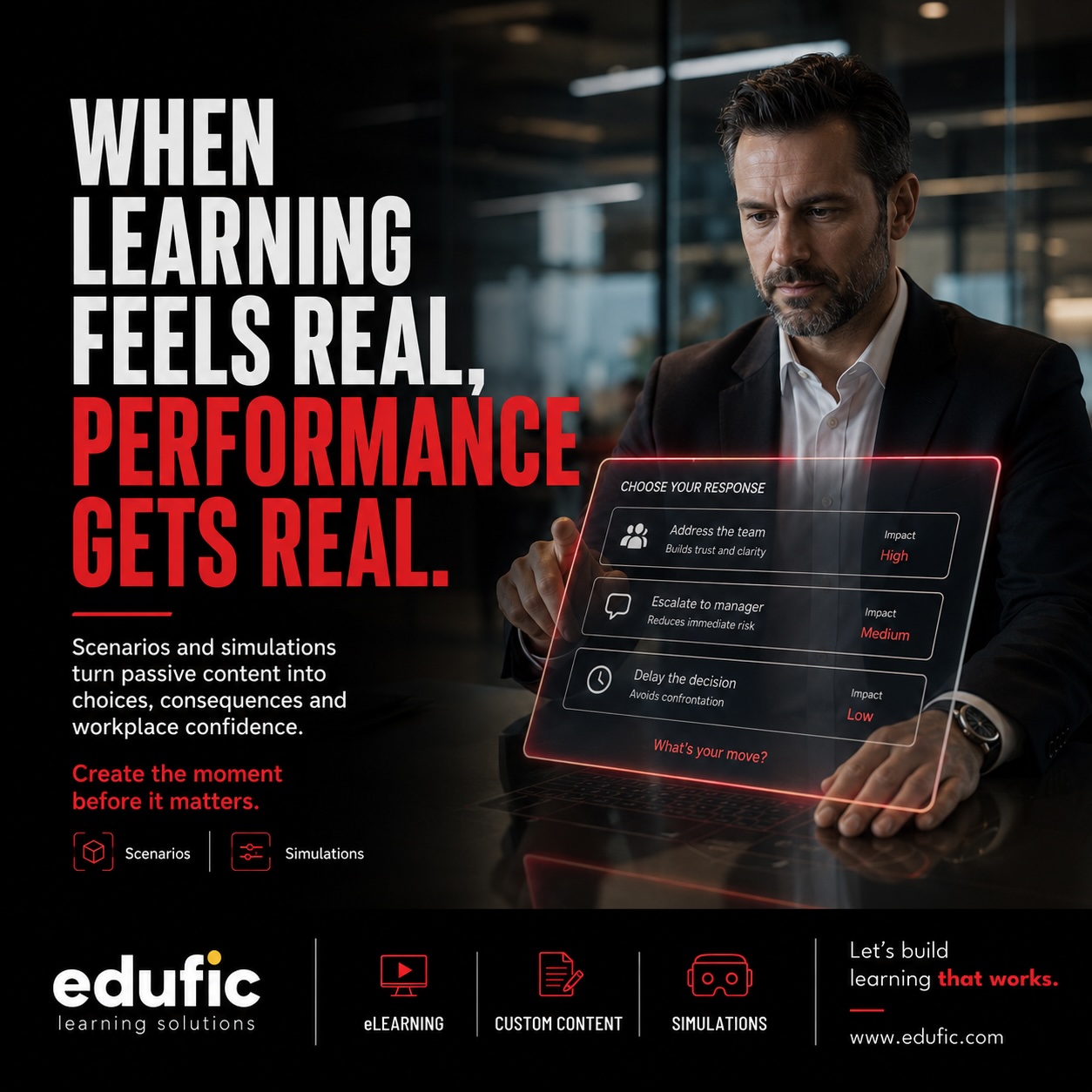

When Learning Feels Real, Performance Gets Real
Corporate learning should prepare people for the moments that matter.
Not just for the assessment.
Not just for the completion certificate.
Not just for the LMS report.
The real test of learning begins at work, when employees need to make decisions, respond to situations, handle pressure, follow processes and act with confidence.
That is why learning must feel real.
When learning feels real, performance gets real.
At Edufic, we design custom eLearning solutions, scenario-based learning and simulation training that turn passive content into real workplace choices, consequences and practice moments. The goal is simple: help learners understand, apply and perform better when it matters most.
Why Passive Training Does Not Build Performance
Many corporate training programmes still rely heavily on passive learning.
Learners read content. They watch slides. They listen to narration. They click through screens. They answer a few questions. They complete the course.
But completion does not always mean readiness.
A learner may finish a compliance module and still hesitate in a real ethical situation. A manager may complete leadership training and still struggle with a difficult conversation. A sales executive may know the product, but still fail to handle a customer objection. A system user may watch a demo, but still feel unsure when using the live system.
The problem is not always the content.
The problem is that the learning does not create enough practice.
Real performance needs more than information. It needs context, judgement, confidence and application.
What Makes Learning Feel Real?
Learning feels real when it reflects the world of the learner.
It uses familiar roles, real workplace situations, practical decisions, realistic consequences and meaningful feedback. It helps learners see how the content applies to their actual work.
Real learning does not ask only, “Do you remember this?”
It asks:
What would you do in this situation?
What decision would you make?
What risk should you consider?
What would happen next?
How would you respond?
How would you apply this at work?
These are the questions that build capability.
This is where scenario-based learning and simulation training become powerful.
Scenario-Based Learning: From Content to Choices
Scenario-based learning places learners inside a realistic workplace situation.
Instead of simply explaining a rule, process or behaviour, it asks the learner to respond to a situation.
For example:
A customer is upset about a delayed service.
A team member misses a critical deadline.
A manager receives a sensitive complaint.
A sales executive faces a difficult objection.
An employee sees a potential compliance issue.
A process user has to choose the right next step.
In each case, the learner must think, decide and act.
This makes the learning more active and memorable.
Scenario-based learning helps learners practise judgement before they face the real situation. It turns passive content into choices, consequences and feedback.
Why Scenarios Improve Workplace Performance
Scenarios work because they connect learning to real-world context.
Learners do not simply memorise information. They apply it in a situation that feels relevant to their job.
This improves:
Decision-making
Confidence
Knowledge retention
Workplace application
Behaviour change
Engagement
Risk awareness
Customer handling
Leadership readiness
Process adoption
A good scenario helps learners understand not only what to do, but why it matters.
That is what makes the learning useful.
Simulation Training: Practice Before Performance
Simulation training helps learners practise tasks, workflows and decisions in a safe environment.
This is especially useful for software training, process training, ERP training, CRM training, HRMS training, LMS training, banking systems, retail platforms, operational workflows and internal applications.
A simulation allows learners to try the steps before using the real system.
It helps them practise without risk.
This can reduce errors, improve adoption and build confidence.
A demo shows people what to do.
A simulation lets them do it.
That difference matters.
The Role of Feedback in Real Learning
Feedback is one of the most important parts of scenario-based learning and simulation training.
If feedback only says “Correct” or “Incorrect,” it does not teach enough.
Good feedback explains the consequence of the learner’s choice. It shows why one option works better than another. It helps the learner understand the reasoning behind the decision.
Strong feedback should help learners answer:
Why was this the right choice?
What risk did I avoid?
What could have gone wrong?
What should I do differently next time?
How does this apply to my role?
Feedback turns a decision into a learning moment.
It helps learners improve before they face the real situation.
Custom eLearning Makes Scenarios More Relevant
Scenario-based learning works best when it is customised.
Generic scenarios may feel artificial. Custom scenarios feel closer to the learner’s actual work.
For example, a banking compliance scenario should not feel like a generic office story. It should reflect banking risks, customer interactions, internal processes and regulatory expectations.
A retail training scenario should reflect store realities, customer behaviour and frontline decisions.
A leadership scenario should reflect the organisation’s culture, people expectations and performance challenges.
Custom eLearning allows the scenario to be designed around the organisation’s real context.
This makes the learning more relatable, more practical and more effective.
Where Scenario-Based Learning Works Best
Scenario-based learning can be used across many corporate training needs.
Compliance Training
Compliance training becomes stronger when learners practise real workplace dilemmas. This can include data privacy, code of conduct, anti-bribery, information security, POSH, ethics, risk awareness and workplace conduct.
Onboarding
New employees can use scenarios to understand culture, expectations, systems, team behaviours and workplace situations.
Leadership Development
Managers can practise coaching, feedback, conflict handling, delegation, performance conversations and decision-making.
Customer Service Training
Learners can practise handling complaints, escalations, service recovery and difficult customer conversations.
Sales Training
Sales teams can practise objection handling, discovery conversations, product positioning and negotiation.
Process Training
Learners can practise decision points, exceptions and workflow steps.
Software Training
System simulations help learners practise using tools before working in live environments.
Across all these use cases, the focus is the same: practise before performance matters.
Why Realistic Learning Builds Confidence
Confidence grows when learners know what to do and have had the chance to try.
A learner who has faced a realistic scenario is more prepared than a learner who has only read about the situation.
A learner who has completed a simulation is more confident than a learner who has only watched a demo.
A learner who has received useful feedback is more ready than a learner who has only passed a quiz.
Confidence is not built through information alone.
It is built through guided practice.
That is why realistic learning experiences are so valuable in corporate training.
AI Video Learning and Realistic Scenarios
AI video learning can help make scenarios more visual, scalable and engaging.
AI-assisted videos, avatar-led scenes and scenario videos can bring workplace situations to life. They can help learners see conversations, body language, tone, decisions and consequences.
This is useful for:
Leadership training
Compliance training
Customer service training
Sales training
Onboarding
Workplace behaviour training
Process explainers
Microlearning
But AI video still needs strong instructional design.
The script must be clear. The scenario must be realistic. The decision points must matter. The feedback must be useful.
At Edufic, we use AI as a production accelerator while keeping learning design at the centre.
AI can make production faster.
Human learning design makes the experience meaningful.
From Completion to Capability
Many organisations still measure learning mainly through completion rates.
Completion is important, but it is not enough.
The stronger question is: can learners use what they learned?
Can they make better decisions?
Can they apply the process?
Can they handle real situations?
Can they reduce errors?
Can they act with confidence?
Can they improve workplace performance?
Scenario-based learning and simulation training help shift the focus from completion to capability.
They help organisations build learning that is not only completed, but used.
How Edufic Builds Real Learning Experiences
At Edufic, we design digital learning that helps people practise real workplace performance.
Our services include:
Custom eLearning development
Scenario-based learning
Simulation training
AI video learning
Instructional design
Storyboard development
Process training
Compliance training
Onboarding training
Leadership learning
Customer service training
Sales training
SCORM-ready course development
Learning videos
Microlearning
Performance support tools
We build learning around your goals, your people and your workflows.
Our focus is to make learning clear, practical, engaging and useful at work.
Learning Should Prepare People for the Real Moment
The real value of corporate learning is not in the module.
It is in the moment after the module.
The customer conversation.
The compliance decision.
The system task.
The leadership conversation.
The process exception.
The workplace challenge.
That is where learning proves itself.
When learning feels real, learners pay attention. They practise better. They remember more. They apply with confidence.
And when learners apply with confidence, performance improves.
When Learning Feels Real, Performance Gets Real
Corporate learning should not be passive.
It should help people think, choose, practise and perform.
At Edufic, we create custom eLearning, scenario-based learning, simulation training, AI video learning and SCORM-ready digital courses that prepare learners for real workplace moments.
Create the moment before it matters.
Let’s build learning that works.
#Edufic #Elearning #CustomElearning #ScenarioBasedLearning #SimulationTraining #CorporateLearning #DigitalLearning #LearningDesign #InstructionalDesign #CorporateTraining #EmployeeTraining #WorkplaceLearning #PerformanceSupport #ComplianceTraining #LeadershipTraining #OnboardingTraining #ProcessTraining #AIVideoLearning #SCORM #LearningAndDevelopment
Meta Title: When Learning Feels Real, Performance Gets Real | Edufic Digital
Meta Description: Discover how scenario-based learning, simulation training and custom eLearning help employees practise real workplace decisions, build confidence and improve performance.
Suggested URL Slug: scenario-based-learning-real-workplace-performance