
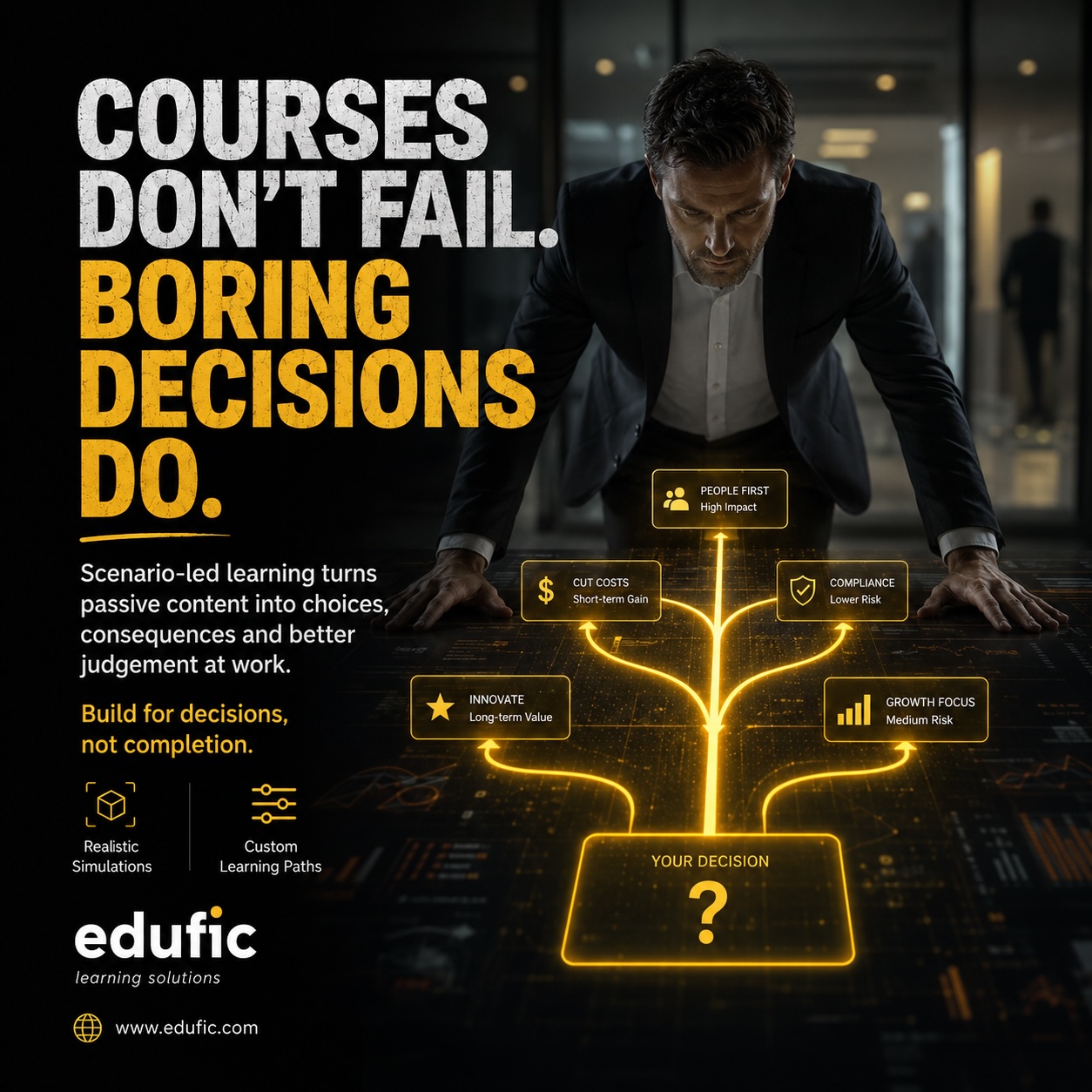

Courses Don’t Fail. Boring Decisions Do.
Most corporate learning does not fail because the topic is unimportant.
Compliance matters. Onboarding matters. Leadership matters. Sales readiness matters. Customer service matters. Process training matters. System adoption matters.
The problem is not the subject.
The problem is how the learner experiences it.
Too often, corporate training asks people to sit through information, remember rules, click through slides and pass a quiz. The learner may complete the course, but they may not be ready for the real workplace moment.
Because the workplace does not ask people to remember slides.
It asks them to make decisions.
That is why scenario-based learning is so powerful.
At Edufic, we design custom eLearning solutions that turn passive content into realistic choices, consequences, feedback and application. Through scenario-based learning, simulations, AI video learning and SCORM-ready digital courses, we help learners practise the moments that matter before they face them at work.
The goal is not just course completion.
The goal is better judgement.
Why Traditional Courses Often Feel Passive
Many corporate training programmes are built around content delivery.
The course explains a policy. It describes a process. It lists the rules. It presents the steps. It gives the learner a final assessment.
This approach may work for basic awareness, but it is not enough when learners need to act in real situations.
For example:
A compliance learner does not only need to know the policy. They need to know what to do when they see a risky situation.
A manager does not only need to understand feedback principles. They need to handle a difficult conversation.
A customer service employee does not only need to know escalation rules. They need to decide how to respond when a customer is upset.
A salesperson does not only need product knowledge. They need to choose the right message in a real customer conversation.
A system user does not only need a demo. They need to practise the workflow.
When training does not include decision-making, learners may understand the information but still hesitate when it matters.
That is where boring decisions become a learning problem.
What Makes a Decision Boring in eLearning?
A boring decision is not simply an easy question.
It is a decision that does not feel real.
Many eLearning courses include knowledge checks that ask learners to identify the correct answer from obvious options. These questions may test memory, but they rarely build judgement.
A boring decision often looks like this:
The correct answer is too obvious.
The wrong answers are unrealistic.
The situation has no workplace context.
There is no consequence.
The feedback is generic.
The learner does not need to think deeply.
The question does not reflect real pressure, ambiguity or trade-offs.
In real work, decisions are rarely that clean.
Employees often need to balance priorities, interpret situations, manage risk, communicate carefully and choose the best next step with limited information.
Scenario-based learning helps recreate that complexity in a safe and structured way.
Scenario-Based Learning Turns Information into Judgement
Scenario-based learning places learners inside realistic workplace situations.
Instead of asking, “Do you remember the rule?” it asks, “What would you do here?”
This changes the learning experience.
The learner must think, choose and reflect. They see the possible consequence of their choice. They receive feedback that explains why one action is stronger than another. They build confidence before facing the real situation.
A good scenario helps learners practise judgement.
It turns information into action.
It helps learners understand not only what the right answer is, but why it matters.
This is especially useful for corporate training topics where behaviour, decision-making and application are more important than simple recall.
Where Scenario-Based Learning Works Best
Scenario-based learning can be used across many corporate learning areas.
Compliance training
Compliance is one of the strongest use cases for scenarios. Policies become meaningful when learners see how they apply in real workplace dilemmas. Scenario-based compliance training can help employees practise ethical decisions, data privacy choices, anti-bribery responses, information security actions and workplace conduct expectations.
Onboarding
New employees need more than company information. They need to understand workplace expectations, team behaviours, systems, processes and cultural norms. Scenarios can help new hires practise common first-week or first-month situations.
Leadership training
Managers often learn best through people situations. Scenario-based leadership training can help managers practise feedback conversations, delegation, conflict resolution, performance management and coaching.
Customer service training
Customer service depends on judgement, tone and response quality. Scenarios can help learners practise handling complaints, escalations, difficult customers and service recovery moments.
Sales training
Sales readiness is not only about product knowledge. Learners need to practise questioning, positioning, objection handling and choosing the right response based on customer context.
Process training
Processes often include exceptions and decision points. Scenarios help learners understand what to do when the workflow is not straightforward.
Safety training
Safety learning becomes stronger when learners identify hazards, assess risks and choose safe actions in realistic situations.
In all these areas, scenario-based learning helps move learners from knowing to doing.
The Role of Consequences in Learning
Consequences make scenarios memorable.
When learners make a choice and see what happens next, the learning becomes more meaningful. They understand the impact of their actions without facing real-world risk.
For example, a learner may choose to ignore a small compliance concern. The scenario can show how that decision creates a bigger issue later.
A manager may choose to avoid a difficult conversation. The scenario can show how silence affects team trust and performance.
A customer service employee may respond too quickly without listening. The scenario can show how the customer’s frustration increases.
These consequences do not need to be dramatic. They need to be realistic.
The purpose is not to punish the learner. The purpose is to help them see cause and effect.
That is how learning builds judgement.
Feedback Makes the Learning Stick
A scenario is only as strong as its feedback.
If feedback simply says “Correct” or “Incorrect,” the learning opportunity is wasted.
Good feedback explains:
Why the choice worked
Why another choice was weaker
What risk was avoided
What behaviour should be repeated
What the learner should remember
How the decision applies at work
Feedback should feel like coaching.
It should help the learner improve their thinking, not just confirm whether they selected the right option.
At Edufic, we design feedback loops that help learners understand the reasoning behind decisions. This supports stronger application and better workplace readiness.
Simulations: Practice Before Performance
Scenario-based learning is especially powerful when combined with simulations.
A simulation allows learners to practise a task, process or system workflow in a safe digital environment.
For example, learners can practise:
Using a software platform
Following an ERP or CRM workflow
Completing a process step
Responding to a customer situation
Making decisions in a branching scenario
Handling compliance or safety situations
Navigating a role-based task
Simulations help learners build confidence before performance matters.
They reduce the gap between training and real work.
A course tells learners what to do.
A simulation lets them try.
AI Video Learning and Scenario Practice
AI video learning can add another layer of realism to scenario-based training.
AI-assisted videos, avatar-led scenes and video-based scenarios can help learners see workplace situations unfold visually. This is useful when tone, emotion, body language or conversation flow matters.
For example:
A manager giving feedback
A customer raising a complaint
A team member reporting a concern
A compliance dilemma
A sales conversation
A safety incident
A workplace behaviour issue
AI video can help organisations create these situations faster and at scale.
But the learning still needs strong scripting, instructional design and review. AI can support production speed, but human learning design ensures the scenario is relevant, accurate and useful.
At Edufic, we use AI-assisted production where it adds value, while keeping learning design and business context at the centre.
Why Custom eLearning Matters for Scenario-Based Training
Scenario-based learning works best when it reflects the learner’s real world.
Generic scenarios may be better than no scenarios, but custom scenarios are stronger because they use the organisation’s actual context, roles, language, processes and risks.
A banking scenario should feel different from a retail scenario.
A manufacturing safety scenario should feel different from an aviation safety scenario.
A sales scenario should reflect the actual customer conversation.
A compliance scenario should reflect real policy expectations and workplace risks.
Custom eLearning allows scenarios to be designed around the organisation’s realities.
This helps learners recognise the situation, relate to it and apply the learning more confidently.
From Completion to Capability
One of the biggest shifts in corporate learning is moving from completion to capability.
Completion asks: Did the learner finish the course?
Capability asks: Can the learner apply what they learned?
Scenario-based learning supports capability because it gives learners the chance to practise decision-making before real performance is required.
A learner who has faced a realistic scenario is more likely to feel prepared.
A learner who has received meaningful feedback is more likely to improve.
A learner who has practised decisions is more likely to apply judgement at work.
That is why scenario-based learning is not just an engagement tool.
It is a performance tool.
Designing Better Decisions in eLearning
To create meaningful decisions in eLearning, organisations need to think beyond simple quiz questions.
A strong learning decision should include:
A realistic situation
A clear role for the learner
A meaningful choice
Plausible options
A consequence or outcome
Specific feedback
A connection to workplace application
The decision should feel close enough to real work that the learner can imagine facing it.
The best scenarios do not simply test whether learners remember the content.
They help learners practise how to think.
How Edufic Builds Scenario-Based Learning
At Edufic, we design custom digital learning experiences that help learners understand, practise and apply.
Our scenario-based learning approach may include:
Workplace situations
Branching choices
Realistic dialogue
Character-led scenarios
Video-based scenes
AI-assisted scenario videos
Decision points
Feedback loops
Simulations
Role-based paths
Knowledge checks
Assessments
SCORM-ready delivery
We build scenarios for onboarding, compliance training, leadership development, customer service, sales readiness, process training, safety training and workplace behaviour learning.
Our focus is to make learning practical, relevant and performance-led.
Because good learning should prepare people for the moments that matter.
Courses Don’t Fail. Boring Decisions Do.
A course may look polished, but if the decisions are weak, the learning will be weak.
Learners need more than information. They need practice. They need context. They need consequences. They need feedback. They need confidence.
Scenario-based learning gives them that.
It turns passive content into active judgement.
It helps people practise before the real moment.
It supports stronger performance at work.
At Edufic, we design custom eLearning, simulations, AI video learning and SCORM-ready courses that help learners make better decisions.
Build for decisions, not completion.
Let’s build learning that works.
#Edufic #Elearning #ScenarioBasedLearning #SimulationTraining #CustomElearning #CorporateLearning #DigitalLearning #LearningDesign #InstructionalDesign #CorporateTraining #EmployeeTraining #WorkplaceLearning #ComplianceTraining #LeadershipTraining #OnboardingTraining #ProcessTraining #AIVideoLearning #SCORM #LearningAndDevelopment #PerformanceSupport
Meta Title: Why Scenario-Based Learning Builds Better Workplace Decisions | Edufic Digital
Meta Description: Discover how scenario-based learning, simulations and custom eLearning help employees practise real workplace decisions, improve judgement and build stronger performance.
Suggested URL Slug: scenario-based-learning-better-workplace-decisions