
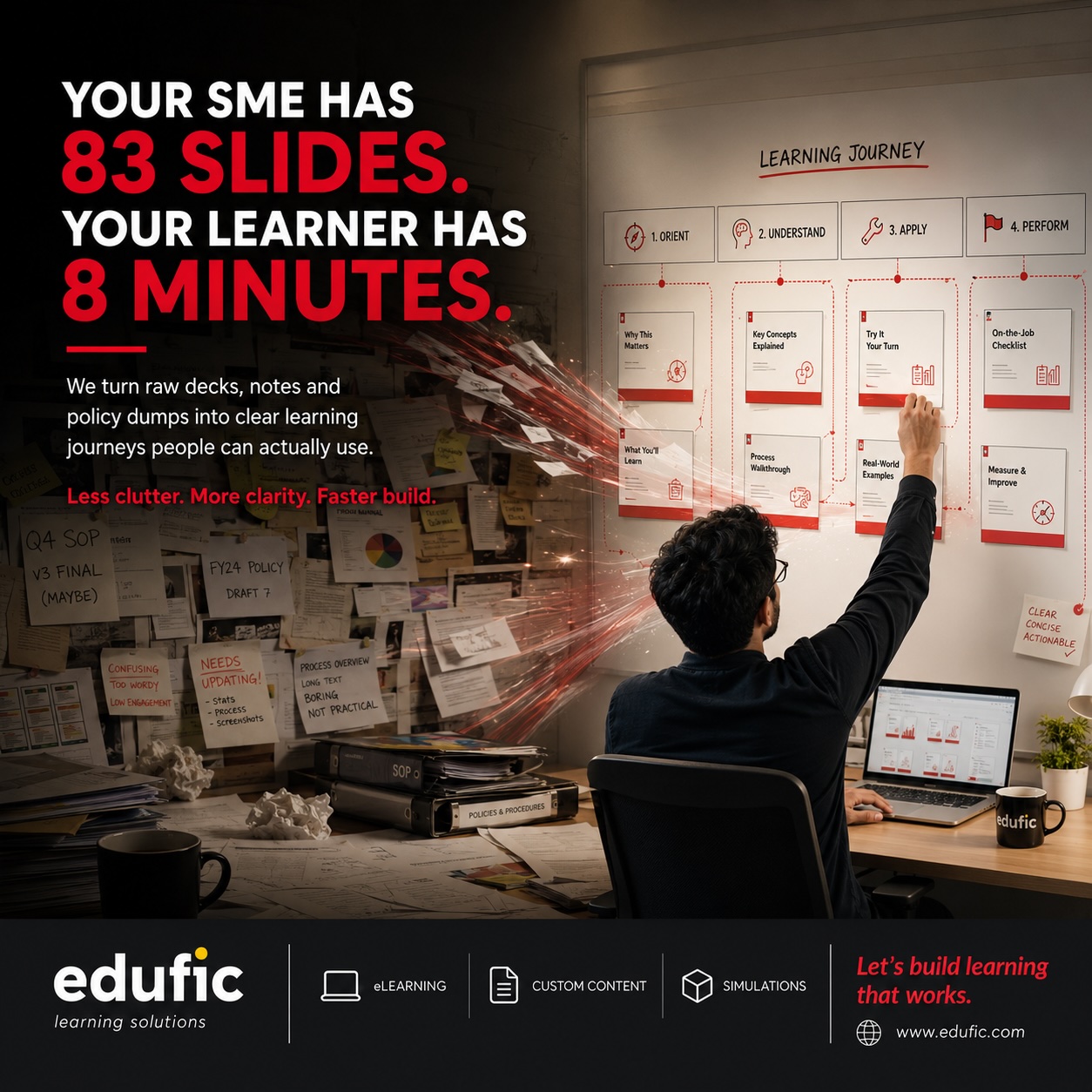

Your SME Has 83 Slides. Your Learner Has 8 Minutes.
This is one of the most common realities in corporate learning.
A subject matter expert has deep knowledge. The business has detailed content. The compliance team has policies. The process team has documents. The operations team has screenshots. The project folder has multiple versions of the same deck.
And somewhere inside all of that, there is a course the learner actually needs.
The challenge is not the availability of content.
The challenge is clarity.
Most corporate learning projects do not fail because there is too little information. They fail because there is too much information without a clear learning journey.
At Edufic, we help organisations transform SME decks, policy documents, process notes and raw content into structured custom eLearning experiences that people can understand, apply and use at work.
Less clutter. More clarity. Faster build.
Why SME Content Often Overwhelms Learners
Subject matter experts are essential to any learning project. They bring accuracy, context and domain depth. They know the process, the policy, the product, the system and the exceptions.
But SME knowledge is not always learner-ready.
An SME may need 83 slides to explain the full topic. A learner may only have a few minutes of attention, a specific job need and a real workplace decision to make.
This creates a gap.
The SME thinks in terms of completeness.
The learner needs usefulness.
The SME may want to include every detail.
The learner needs to know what matters now.
The SME may provide documents, references and exceptions.
The learner needs a clear path to action.
Good instructional design helps bridge this gap.
It respects the expertise of the SME while shaping the content into a learning experience that is clear, relevant and practical.
Content Is Not the Same as Learning
Many training projects start with a request to convert a PowerPoint deck into eLearning.
But conversion is not learning design.
A slide deck can be full of useful information and still fail as a course. A policy document can be accurate and still feel difficult to apply. A process manual can be detailed and still leave learners confused.
Learning is not about transferring every available piece of information to the screen.
Learning is about helping people understand what they need to do.
That means the content must be structured, simplified, sequenced and connected to real work.
A strong custom eLearning experience answers the learner’s questions:
Why does this matter?
What do I need to know?
What should I do differently?
How does this apply to my role?
What does good performance look like?
Where can I practise?
What should I remember later?
When learning answers these questions, it becomes useful.
And useful learning gets applied.
The Problem with Content Dumps
A content dump happens when all available material is placed into a course without enough learning design.
It may include too much text, too many definitions, too many slides, too many policy extracts and too little learner guidance.
The result is often a course that looks complete but feels heavy.
Learners may complete the module because it is mandatory, but they may not remember it or apply it. They may click through the screens, pass the assessment and still feel unsure about what to do at work.
This is a major issue in corporate learning, especially in areas such as compliance training, onboarding, process training, product training and system training.
The goal should not be to include everything.
The goal should be to include what helps the learner perform.
From Raw Content to Learning Journey
A learning journey gives structure to content.
It helps learners move from awareness to understanding, from understanding to practice and from practice to application.
Instead of presenting information randomly, a learning journey creates flow.
A good learning journey may include:
A clear opening that explains why the topic matters
Focused learning objectives
Simple explanations of key concepts
Real workplace examples
Scenario-based decisions
Interactive practice
Knowledge checks
Feedback
Summary and reinforcement
Performance support or job aids
This approach makes learning easier to follow and easier to apply.
At Edufic, we turn raw SME inputs into structured storyboards and digital learning journeys that reduce overload and improve learner clarity.
Why Instructional Design Matters
Instructional design is the discipline that turns content into learning.
It helps decide what should be taught, what should be simplified, what should become a scenario, what should be shown visually, what should be practised and what should be assessed.
Without instructional design, a course may become a digital version of a document.
With instructional design, the course becomes a guided experience.
Instructional design helps answer critical questions:
Who is the learner?
What does the learner already know?
What does the learner need to do after the course?
What content is essential?
What can be removed?
What can become reference material?
Where does the learner need a scenario?
Where does the learner need feedback?
How will learning success be measured?
These questions help transform SME knowledge into learner clarity.
The Role of Storyboarding in eLearning Development
A storyboard is the blueprint of the course.
It shows how the learning experience will work before development begins. It defines the screen flow, on-screen text, voice-over, visuals, interactions, scenarios, assessments and feedback.
A good storyboard helps align SMEs, business stakeholders, learning teams and developers.
It also reduces rework.
When everyone can see the learning flow early, feedback becomes clearer. The team can identify gaps, remove unnecessary content and improve the learner journey before development starts.
For custom eLearning, storyboarding is where clarity begins.
It is the stage where content stops being a pile of information and starts becoming a learning experience.
Making SME Knowledge Learner-Friendly
SME knowledge can be powerful when it is translated properly.
This does not mean making the content shallow. It means making the content usable.
For example:
A detailed policy can become a scenario-based compliance module.
A technical process can become a visual process walkthrough.
A system manual can become a simulation.
A product deck can become role-based sales training.
A long onboarding presentation can become a structured learning path.
A dense SOP can become a quick reference guide with practice moments.
The goal is to keep the accuracy of the source content while improving its clarity, flow and relevance.
At Edufic, we help organisations preserve subject matter expertise while making learning easier for employees to understand and apply.
Why Learners Need Less Clutter
Learners are busy.
They are handling customers, systems, processes, deadlines, targets, compliance expectations and team responsibilities. They do not have unlimited attention.
When learning is cluttered, learners struggle to identify what matters.
Clutter creates cognitive load. It slows understanding. It reduces confidence. It makes the learning feel longer than it really is.
Clear learning does the opposite.
It helps learners focus.
It highlights what matters. It uses visuals to simplify complexity. It breaks content into manageable sections. It gives learners practice where they need it. It separates must-know content from reference content.
Less clutter does not mean less value.
It means better learning value.
Using Scenarios to Improve Application
One of the best ways to make learning practical is to use scenarios.
Scenarios help learners see how the content applies in real workplace situations.
Instead of only telling learners what a policy says, a scenario shows them a situation where the policy matters. Instead of only explaining a process, a scenario helps learners make a decision inside that process.
Scenario-based learning works well for:
Compliance training
Ethics training
POSH training
Information security training
Customer service training
Sales training
Leadership training
Onboarding
Safety training
Workplace behaviour training
Scenarios turn information into judgement.
They help learners practise before they face real situations.
Using Simulations to Build Confidence
For system and process training, simulations are especially useful.
A simulation allows learners to practise steps in a safe environment. This is more effective than simply showing screenshots or explaining a workflow.
Simulation training is useful for ERP training, CRM training, HRMS training, LMS training, banking systems, retail systems, internal business applications and operational workflows.
Simulations help learners build confidence before they use the real system.
They also support faster adoption, fewer errors and better process consistency.
This is how learning moves from knowing to doing.
AI Video Learning and Faster Production
AI can help accelerate the creation of learning assets.
AI-assisted videos, avatar-led explainers, synthetic voice and visual generation can reduce production time and support faster rollout.
But AI should not be used to simply create more content faster.
It should be used to create better learning faster.
At Edufic, we use AI as an accelerator while keeping human instructional design, scripting, visual direction and quality assurance at the centre.
This helps organisations produce learning quickly while still maintaining clarity, relevance and learning value.
AI brings speed.
Learning design brings impact.
SCORM-Ready Courses for Enterprise Rollout
Once the learning is designed, it needs to be delivered and tracked.
SCORM-ready courses allow organisations to deploy learning through a Learning Management System and track completion, assessment scores and learner progress.
This is important for enterprise learning programmes, onboarding, compliance rollouts, process training and mandatory employee training.
At Edufic, we develop SCORM-ready and LMS-compatible digital learning that supports consistent delivery across teams and locations.
But SCORM packaging is only part of the solution.
The course itself must still be learner-friendly, well-structured, accurate and practical.
Technical readiness and learning clarity must go together.
Faster Build Does Not Mean Rushed Learning
When content is messy, production slows down.
Teams spend time clarifying source material, resolving contradictions, managing SME feedback and trying to decide what belongs in the course.
A clear instructional design process helps speed up development because it creates structure early.
Faster build comes from better alignment, not shortcuts.
When the learning journey is clear, storyboarding becomes smoother. Review cycles become more focused. Visual design becomes more purposeful. Development becomes more efficient. QA becomes more manageable.
At Edufic, we help organisations move faster by creating clarity at the start.
Less clutter. More clarity. Faster build.
How Edufic Turns SME Slides into Digital Learning
Edufic helps organisations transform raw content into custom digital learning experiences.
Our services include:
Custom eLearning development
Instructional design
Storyboard development
Scenario-based learning
Simulation training
AI video learning
Process training
Onboarding training
Compliance training
Microlearning
Mobile learning
SCORM-ready course development
Learning videos
Quality assurance
We work with SMEs, L&D teams, business teams and stakeholders to identify what matters, simplify what is complex and build learning that supports real workplace performance.
The aim is not to create more screens.
The aim is to create better learning.
From 83 Slides to 8 Minutes of Clarity
Your SME may have 83 slides.
Your learner may have 8 minutes.
The job of good learning design is to make those 8 minutes count.
It is to find the essential message, structure the learning journey and help the learner understand what to do.
At Edufic, we turn raw decks, SME inputs, policy dumps and process notes into clear custom eLearning journeys that people can actually use.
We reduce clutter.
We improve clarity.
We build faster.
We help learning work better.
Because learners do not need every slide.
They need the right learning at the right time, in the right flow.
Let’s build learning that works.
#Edufic #Elearning #CustomElearning #CorporateLearning #DigitalLearning #InstructionalDesign #LearningDesign #LearningExperienceDesign #CorporateTraining #EmployeeTraining #WorkplaceLearning #Storyboarding #ContentToCapability #ProcessTraining #ComplianceTraining #OnboardingTraining #SimulationTraining #AIVideoLearning #SCORM #LearningAndDevelopment
Meta Title: From SME Slides to Clear eLearning Journeys | Edufic Digital
Meta Description: Learn how Edufic turns long SME decks, policy dumps and process documents into clear custom eLearning journeys, simulations, AI video learning and SCORM-ready courses that learners can understand and apply.
Suggested URL Slug: sme-slides-to-clear-elearning-journeys